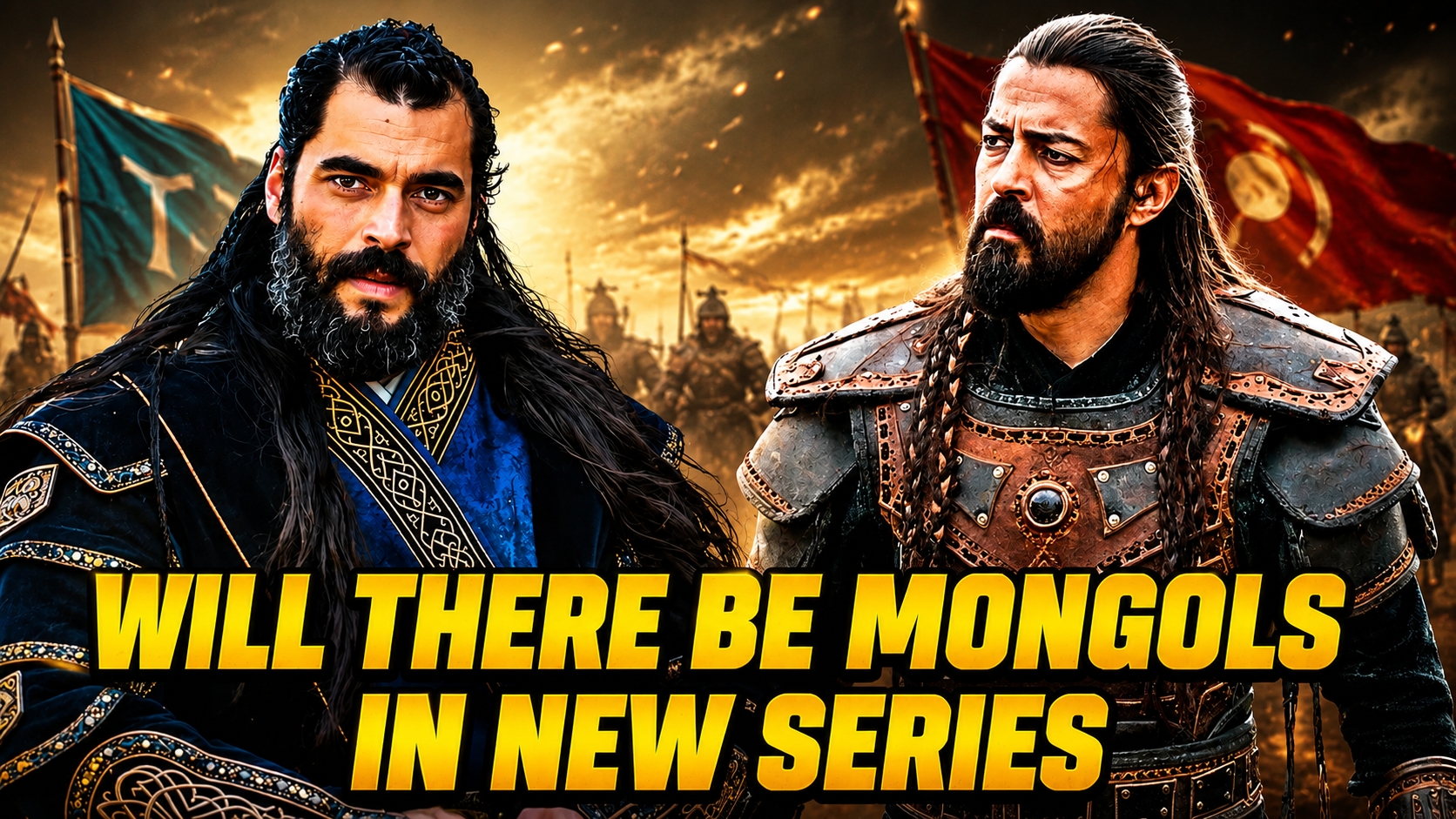
When Mehmet Bozdağ officially announced his upcoming historical drama Aşk ve Taht, one question immediately started circulating among fans: Will the Mongols appear in the series? It’s an understandable question. Anyone who watched Diriliş: Ertuğrul remembers the Mongols as one of the greatest threats faced by the Turkish tribes. Since the Seljuk Empire eventually collapsed under Mongol pressure, many viewers naturally expect the same storyline to begin from the very first season of Aşk ve Taht. However, real history tells a different story.
Why Aşk ve Taht Is Different From Diriliş: Ertuğrul
Before discussing the Mongols, it’s important to understand the difference between the two series.
Very little historical information survives about the everyday life of Ertuğrul Bey. Because of this, the writers of Diriliş: Ertuğrul had plenty of freedom to create fictional characters, imagined battles, and dramatic storylines.
Aşk ve Taht is a completely different case.
The series focuses on Sultan Alaeddin Keykubad I, one of the greatest rulers of the Seljuk Sultanate of Rum. Unlike Ertuğrul, Alaeddin Keykubad’s reign is extensively documented by historians. That gives Mehmet Bozdağ much stronger historical material to work with and leaves far less room for completely fictional events.
Where Were the Mongols in 1220?
If Aşk ve Taht begins shortly after Alaeddin Keykubad ascends the Seljuk throne, the story would likely start around 1220 CE.
So where were the Mongols during that time?
The answer is simple: they were nowhere near the Seljuk Sultanate.
Although Genghis Khan was actively expanding his empire, his attention was focused entirely on Central Asia. At the time, he was fighting a massive campaign against the Khwarazmian Empire, whose territory stretched across parts of present-day Iran, Afghanistan, Turkmenistan, and Azerbaijan.
The Fall of the Khwarazmian Empire
Fans of Mehmet Bozdağ may recognize this conflict.
Bozdağ previously produced the historical series Jalaluddin, which tells the story of Jalal ad-Din Mingburnu, the final ruler of the Khwarazmian Empire.
In 1221, Genghis Khan defeated Jalal ad-Din in a decisive battle. According to historical accounts, Jalal ad-Din escaped by riding his horse into the Indus River, near present-day Attock, Pakistan. Although he survived and attempted to rebuild his forces, he was ultimately unable to restore his empire.
Why the Seljuks Were Safe—At Least for a While
After defeating the Khwarazmians, the Mongols did not invade Seljuk territory.
Instead, Genghis Khan’s armies continued their campaigns toward Russia and Eastern Europe, pushing into regions that would later include Poland and Hungary.
As a result, the Seljuk Sultanate experienced virtually no direct Mongol invasion during the early 1220s.
When Did the Mongols Become a Threat?
The situation began to change only after 1235.
During this period, the Mongol Empire gradually expanded westward, and pressure on the Seljuk frontier slowly increased. These early encounters were limited to small border raids, not large-scale invasions.
This timeline actually matches what viewers saw in Diriliş: Ertuğrul.
Season 2 depicts occasional Mongol raids affecting frontier tribes, including those connected to Ertuğrul’s family. By Season 3, after Ertuğrul relocates, Mongol activity becomes much less noticeable because historically there simply wasn’t a major Mongol campaign in the region yet.
The Battle That Changed Everything
The real turning point came in 1242, when Mongol commander Baiju Noyan launched the first major offensive against the Seljuk Sultanate.
One year later, in 1243, the Seljuk and Mongol armies met at the Battle of Köse Dağ.
The result was catastrophic for the Seljuks.
Their army suffered a crushing defeat, and the once-powerful Seljuk Sultanate was forced into becoming a Mongol vassal state. This period of decline eventually paved the way for the rise of smaller Turkish beyliks, including the early Ottoman state—a development later portrayed in Kuruluş Osman.
Will Mongols Appear in Season 1 of Aşk ve Taht?
Based on the historical timeline, the answer is probably not.
If the first season covers the years between 1220 and the late 1220s, Mongol involvement in Seljuk territory would be extremely limited or completely absent. Their major campaigns against the Seljuks simply had not begun yet.
Of course, Mehmet Bozdağ has often introduced fictional elements to make his historical dramas more engaging. A brief Mongol appearance or an original subplot cannot be ruled out entirely.
However, if the series follows history closely, viewers are much more likely to see the Mongols become major antagonists in later seasons, particularly once the story reaches the 1230s and early 1240s, when the Seljuk-Mongol conflict truly began.
Final Verdict
History suggests that Season 1 of Aşk ve Taht is unlikely to feature the Mongols as major villains. During the early years of Sultan Alaeddin Keykubad’s reign, Genghis Khan was focused on conquering the Khwarazmian Empire, while the Seljuk Sultanate remained largely untouched.
The famous Mongol invasions that weakened the Seljuks occurred much later, culminating in the devastating Battle of Köse Dağ (1243).
So while later seasons may eventually bring the Mongols into the story, fans probably shouldn’t expect them to dominate the opening chapter of Aşk ve Taht.