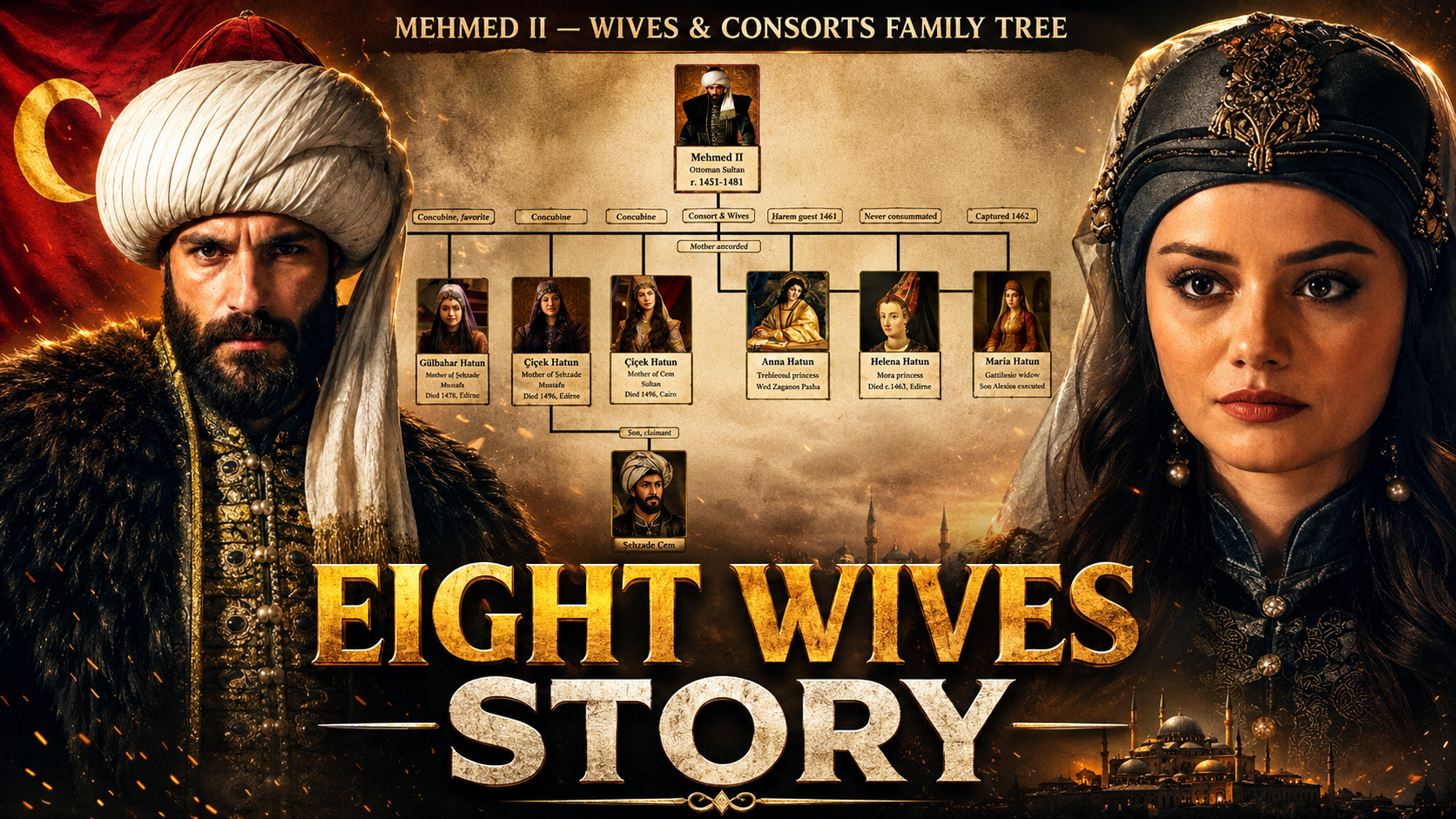
When people think of Sultan Mehmed II, they remember the conqueror who captured Constantinople in 1453 and transformed the Ottoman Empire into a world power. His military victories are celebrated across history, but far less attention is given to the women who became part of his household. Behind the glory of conquest was a world shaped by dynastic politics, diplomatic marriages, royal hostages, and succession struggles. The lives of Mehmed’s wives and concubines reveal a side of Ottoman history that was often far more tragic than romantic.
Who Was Mehmed the Conqueror?
Mehmed II became Ottoman sultan at a young age and forever changed history by conquering Constantinople at just 21 years old. His reign expanded the empire across the Balkans and Anatolia, but his personal life was equally influenced by politics.
Most marriages within the Ottoman dynasty were arranged to strengthen alliances, reward loyal officials, or secure newly conquered territories rather than for love.
Sittişah Mükrime Hatun: The Political Bride
Sittişah Mükrime Hatun became Mehmed’s legal wife in 1450 through a political alliance with the Dulkadir Beylik.
Their wedding celebrations reportedly lasted for months, reflecting the importance of the alliance. However, the marriage produced no children. After Mehmed established Constantinople as his new capital, she remained in Edirne and spent the rest of her life away from the imperial court.
She died in 1467 and was buried beside the mosque she commissioned.
Gülbahar Hatun: Mother of the Next Sultan
Among Mehmed’s consorts, Gülbahar Hatun enjoyed the most influential legacy.
Believed to have been of Balkan origin, she became the mother of Bayezid II, who later succeeded Mehmed as sultan.
When Bayezid ascended the throne, Gülbahar became the empire’s most influential royal mother. She died in 1492 and was buried near Mehmed II, making her one of the few women from his household remembered with lasting prestige.
Gülşah Hatun: Lost to History
Very little reliable information survives about Gülşah Hatun.
She gave birth to Şehzade Mustafa, who later governed Konya before dying in 1474. After Mustafa’s death, historical references to Gülşah largely disappear, leaving historians with few clues about her later life.
Çiçek Hatun: Loyal to Cem Sultan
Çiçek Hatun is remembered primarily as the mother of Cem Sultan.
Following Mehmed’s death, Cem fought his brother Bayezid II for the Ottoman throne. After losing the succession struggle, he spent years in exile across the Middle East and Europe.
According to many historical accounts, Çiçek Hatun remained loyal to her son throughout his difficult years and later died in Cairo.
Anna Hatun: A Political Pawn
Anna Hatun is traditionally associated with the ruling family of the Empire of Trebizond.
After the Ottoman conquest of Trebizond in 1461, later accounts describe her becoming part of Mehmed’s household before eventually being connected with Grand Vizier Zaganos Pasha.
Modern historians debate many details of this story, and the exact nature of her relationship with Mehmed remains uncertain.
Helena Hatun: A Princess in Captivity
Helena Hatun is linked in some Greek sources to the Byzantine imperial family.
These accounts suggest that Mehmed did not marry her but instead settled her in Edirne with financial support while preventing another marriage.
Although parts of this story remain disputed, it illustrates how noblewomen from defeated dynasties often became political hostages after Ottoman conquests.
Maria Hatun: A Tragic Story
Maria Hatun’s story is among the most dramatic traditions connected to Mehmed’s household.
Some historical narratives claim she entered the Ottoman palace after military campaigns in the Black Sea region, while her previous family suffered devastating losses during the conquest.
Because surviving evidence is limited, historians continue to debate several details of her life.
Hatice Hatun: Marriage for Politics
Hatice Hatun, daughter of Grand Vizier Zaganos Pasha, entered Mehmed’s household during the early years of his reign.
Many historians view the marriage as part of broader political arrangements between the sultan and one of his most trusted statesmen. The marriage was relatively brief and reportedly ended in divorce only a few years later.
The Forgotten Children
Ottoman genealogy also records several sons and daughters whose mothers remain uncertain.
Among them are Şehzade Nureddin, who died in infancy, and daughters including Ayşe Hatun, Fülane Hatun, and Kamerhan Hatun. Their limited documentation reminds us that even within the imperial family, many lives faded from the historical record.