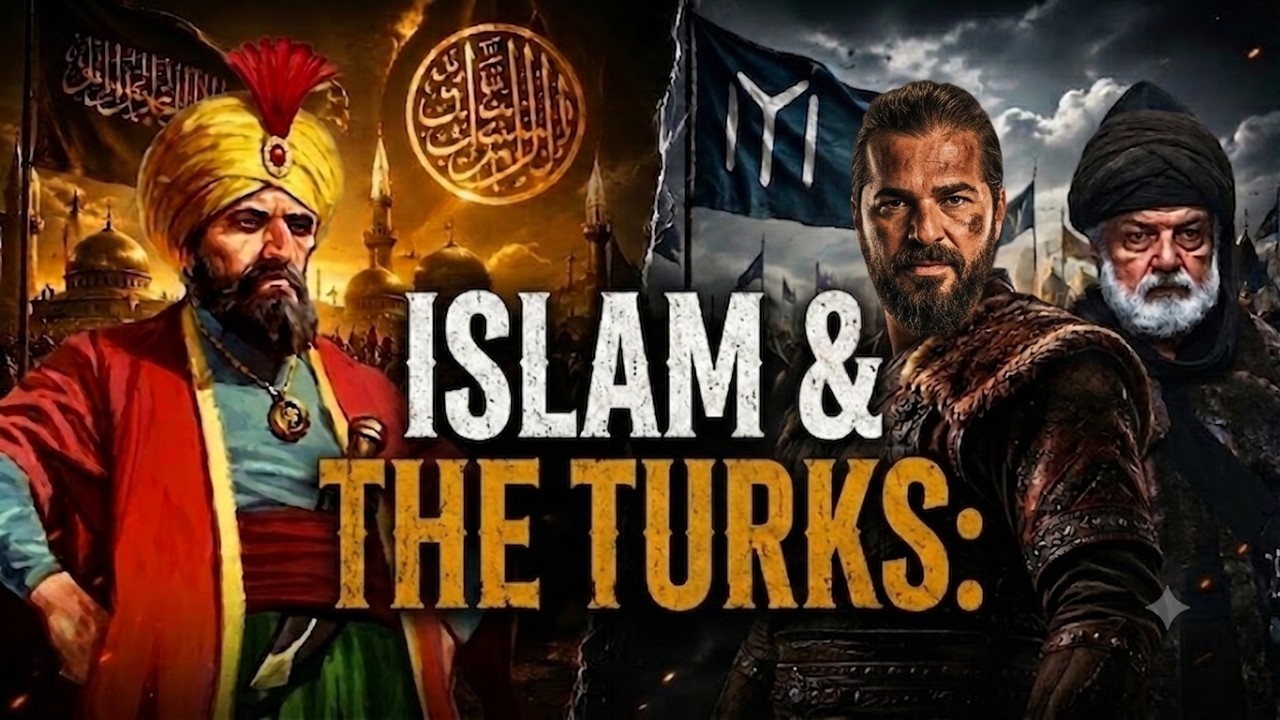
One of the most debated questions in medieval history is whether the Turks were forced to convert to Islam or whether they embraced the faith voluntarily. While military campaigns certainly played a role in early contact between Muslim armies and Turkic tribes, the historical evidence tells a far more complex story. The conversion of the Turks was not a single event but a centuries-long process shaped by trade, cultural exchange, political alliances, religious similarities, and influential leaders. Rather than a simple tale of conquest, it was the gradual transformation of one of history’s greatest civilizations. Let’s explore what really happened.
Who Were the Turks Before Islam?
Long before they became known as defenders of the Islamic world, the Turkic peoples lived as nomadic tribes across the vast steppes of Central Asia.
Around 200 BCE, one of the earliest Turkic empires emerged under the legendary ruler Mete Han (Modu Chanyu). His military reforms created one of the most disciplined cavalry forces of the ancient world and laid the foundation for later Turkic empires.
At this time, Turks were not Muslims or Christians.
Their traditional religion was Tengriism, centered around:
- Belief in Tengri, the eternal Sky God
- Respect for ancestors
- Nature spirits
- Honor and courage
- Loyalty to one’s tribe
These beliefs shaped Turkic society for centuries.
The First Contact Between Turks and Arabs
Contrary to popular belief, Turks and Arabs did not first meet on the battlefield.
They met through commerce.
Along the famous Silk Road, cities such as Samarkand and Bukhara became major trading centers where Arab merchants exchanged spices, perfumes, textiles, and luxury goods for Turkic horses, furs, and livestock.
These peaceful interactions occurred generations before Muslim armies entered Central Asia.
Trade helped establish trust and introduced Turkic peoples to Islamic culture long before widespread conversion began.
The First Major Religious Change Among the Turks
Before Islam spread widely among the Turks, another significant religious transformation had already taken place.
Some Turkic tribes migrated westward into Europe and became associated with the Hunnic Empire under Attila the Hun.
After Attila’s death in 453 CE, the empire quickly collapsed.
Many Turkic groups that remained in Europe gradually adopted Christianity due to their close contact with neighboring Christian societies.
This little-known transition demonstrates that Turkic peoples historically adapted their religious beliefs based on changing political and cultural environments.
The Rise of the Göktürks
Back in Central Asia, another powerful empire emerged.
Under Bumin Qaghan, the Göktürk Khaganate became the first state in history to officially use the name “Turk.”
The Göktürks united numerous nomadic tribes and established one of the strongest empires in Inner Asia.
It was during this era that Islam began expanding beyond Arabia.
Muslim Expansion into Central Asia
During the early eighth century, Muslim commanders—including Qutayba ibn Muslim—led campaigns into Transoxiana, capturing important cities such as:
- Samarkand
- Bukhara
- Khwarazm
These military campaigns are often cited as evidence that Islam spread among the Turks through force.
However, the historical timeline suggests a different story.
Were the Turks Forced to Convert?
If military conquest alone had forced conversion, historians would expect the Turkic population to embrace Islam immediately after these victories.
Instead, large-scale conversion took nearly two centuries.
This gradual process strongly suggests that conquest alone cannot explain the spread of Islam among the Turks.
Many Turkic tribes continued practicing Tengriism long after Muslim armies first entered Central Asia.
The Tax Argument Against Forced Conversion
Another important piece of evidence challenges the forced conversion theory.
Under early Islamic rule, non-Muslims generally paid taxes such as the jizya, while Muslims did not pay this specific tax.
From a financial perspective, governments often collected more revenue from non-Muslim populations.
Historical sources even record instances where officials worried that too many people were converting because tax income was declining.
This suggests that rapid mass conversion was not always encouraged for economic reasons.
Why Did the Turks Accept Islam?
Rather than a single cause, historians identify several major factors behind the Turkic conversion.
1. Similar Religious Beliefs
Tengriism and Islam shared several concepts that made Islam easier for many Turks to understand.
These included:
- Belief in one supreme God
- Moral responsibility
- Respect for honesty
- The importance of justice
- Belief in an afterlife
Although the two religions were fundamentally different, these similarities reduced cultural barriers.
2. Trade and Daily Interaction
Muslim merchants earned strong reputations for honesty and fair dealing.
Through centuries of commercial contact, many Turkic communities encountered Islam not through armies but through everyday relationships.
Trade created trust, and trust opened the door to religious exchange.
3. Military Service in the Abbasid Caliphate
One of the most important turning points came during the Abbasid Caliphate.
Caliph al-Mu’tasim recruited thousands of Turkic slave soldiers, known as mamluks, into the Abbasid military.
These elite troops quickly became famous for their discipline and battlefield effectiveness.
Eventually, their political influence became so great that they began determining who would become caliph.
The city of Samarra was even constructed partly to house these powerful Turkish military forces after tensions grew in Baghdad.
From Slave Soldiers to Kings
The rise of the Turkish military elite transformed the Islamic world.
One remarkable example is Ahmad ibn Tulun.
Although his father had originally entered the Abbasid Empire as a Turkish slave soldier, Ahmad eventually established the Tulunid Dynasty and ruled Egypt as an independent ruler.
Within only a few generations, people originally brought into the empire as military slaves became governors, generals, and kings.
Satuq Bughra Khan and the Great Conversion
Perhaps the most decisive turning point came in the early tenth century.
The Qarakhanid ruler Satuq Bughra Khan voluntarily embraced Islam and adopted the name Abd al-Karim.
Unlike earlier military campaigns, his conversion was not the result of conquest.
It was a personal decision.
His example inspired his people to follow him.
Historical traditions suggest that approximately 200,000 Turkic households accepted Islam during this period, making it one of the largest voluntary religious transformations in Central Asian history.
The Turks Became Defenders of Islam
Following their conversion, Turkic Muslim states expanded westward.
One of the defining moments came in 1071, when the Seljuk Turks defeated the Byzantine Empire at the Battle of Manzikert.
This victory opened Anatolia to permanent Turkic settlement.
Centuries later, the Ottoman Empire would build upon this foundation, transforming Anatolia into the political and cultural center of the Islamic world.
Did the Turks Accept Islam by Force or by Choice?
The historical evidence points toward a far more nuanced answer than many assume.
Military campaigns certainly introduced Muslim rule into parts of Central Asia, but widespread conversion occurred gradually over generations.
Historians generally agree that the spread of Islam among the Turks was influenced by multiple factors, including:
- Long-distance trade
- Cultural interaction
- Shared religious concepts
- Political alliances
- Military service within Islamic states
- The voluntary conversion of influential Turkic rulers
Rather than a single event of forced conversion, it was a centuries-long process shaped by both political realities and individual choices.