

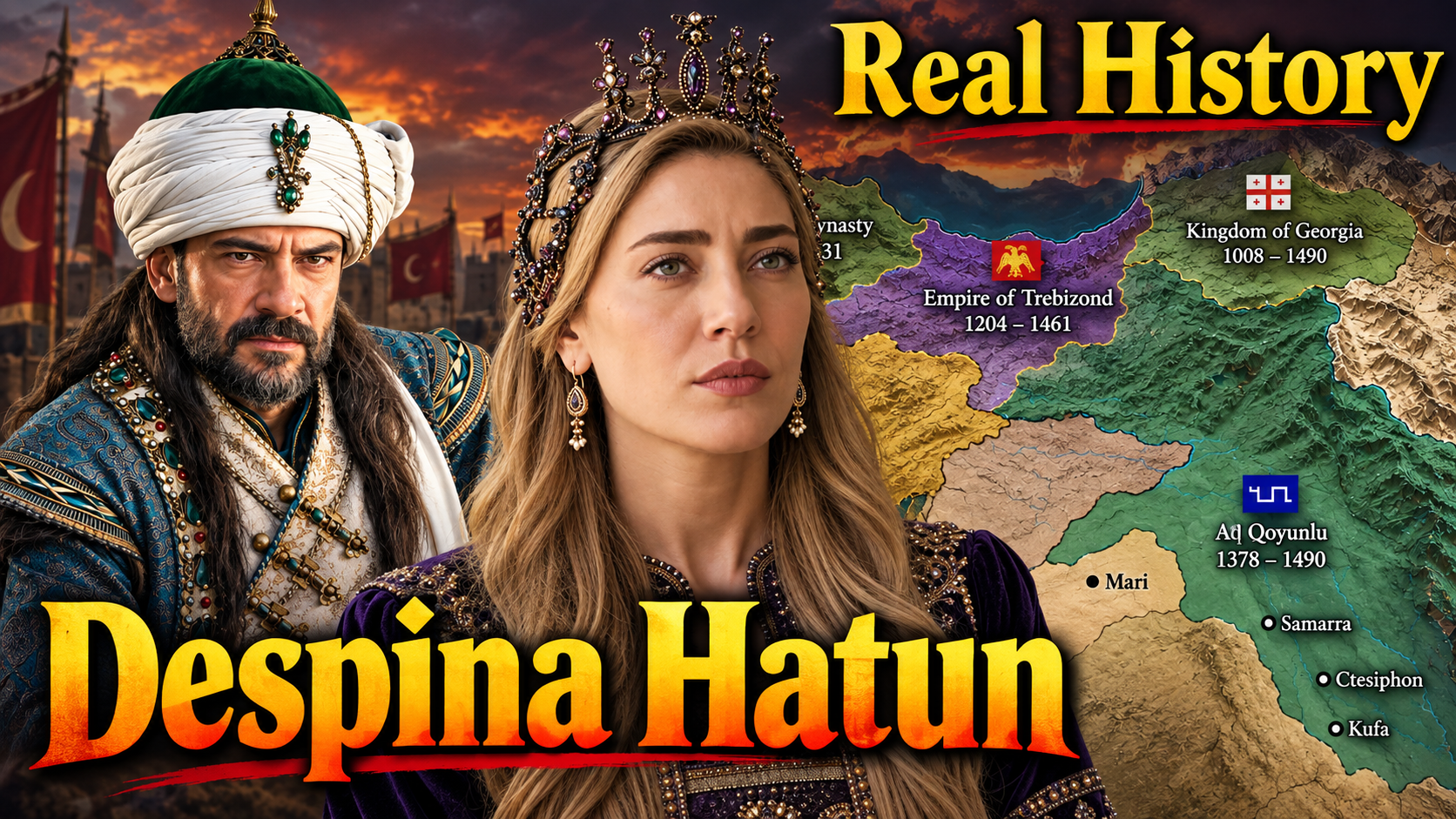
A Byzantine princess married a powerful Muslim ruler to help save her family’s kingdom. Decades later, her bloodline would become connected to the founder of one of the most important empires in Iranian history. That sounds like the plot of a historical drama, but the story of Despina Hatun is rooted in real history. With Öznur Serçeler set to portray Despina Hatun, also known as Destina Hatun, in Mehmed: Fetihler Sultanı Season 4, interest in the historical woman behind the character is growing. The series will naturally dramatize parts of her life, but the real Despina Hatun had a remarkable story involving Byzantine royalty, the Aq Qoyunlu ruler Uzun Hasan, Ottoman Sultan Mehmed II, European diplomacy and, eventually, the Safavid dynasty. So who was Despina Hatun in real history? And how did a princess from Trebizond become connected to the birth of the Safavid Empire?
Who Was Despina Hatun?
The historical woman commonly identified as Despina Hatun was Theodora Megale Komnene, a princess of the Empire of Trebizond.
She was the daughter of Emperor John IV of Trebizond, while her mother was a Georgian princess. This made Theodora a member of the Komnenos dynasty and part of one of the last surviving Byzantine imperial states.
Her life unfolded during one of the most turbulent periods of the 15th century.
The Byzantine Empire had been reduced dramatically, Constantinople was under increasing pressure, and the Ottoman Empire under Sultan Mehmed II was expanding rapidly.
For Trebizond, survival was becoming increasingly difficult.
And that is where Despina’s extraordinary political story began.
Trebizond Was Fighting for Survival
The Empire of Trebizond existed along the southern Black Sea coast and had survived for centuries after the Byzantine Empire had lost much of its former territory.
But by the mid-15th century, its position had become extremely dangerous.
The Ottoman Empire was expanding eastward, while other regional powers competed for influence.
The fall of Constantinople in 1453 made the situation even more alarming.
Sultan Mehmed II had conquered Constantinople, transforming the balance of power in the region.
Trebizond’s rulers knew that they could eventually become the next Ottoman target.
Emperor John IV therefore needed powerful allies.
One of the most important potential partners was Uzun Hasan, the ruler of the Aq Qoyunlu, often translated as the “White Sheep” Turkmen confederation.
An alliance with Uzun Hasan could provide Trebizond with a powerful military and political counterweight to Ottoman expansion.
And in the 15th century, one of the strongest ways to establish such an alliance was through marriage.
Despina Hatun and Uzun Hasan’s Political Marriage
In 1458, Theodora married Uzun Hasan.
This was much more than a personal marriage.
It was a political alliance designed to strengthen Trebizond’s position and connect the Komnenian dynasty with one of the strongest powers in the region.
But there was an important condition associated with the marriage.
Theodora was allowed to continue practicing her Orthodox Christian faith.
This detail is particularly significant because it demonstrates that the marriage was not simply about Theodora being absorbed into Uzun Hasan’s court.
She retained an important degree of religious autonomy.
According to historical accounts, she was accompanied by Orthodox religious figures and maintained connections to the Christian communities within the territories where she lived.
This later contributed to her reputation as a politically influential Christian princess living within a powerful Muslim court.
What Does “Despina Hatun” Mean?
After her marriage, Theodora became known as Despina Hatun.
The name “Despina” comes from the Greek title despoina, associated with a lady or female ruler of high status.
The addition of Hatun reflects the Turkic-Persian political and cultural environment in which she lived.
Over time, she became known in different historical traditions by several names, which can sometimes make researching her biography confusing.
But the woman at the center of these accounts was the Trebizond princess Theodora Megale Komnene.
Despina Hatun Was More Than Uzun Hasan’s Wife
One of the most fascinating aspects of Despina Hatun’s history is that she was not simply a royal wife living quietly inside the palace.
Her position gave her access to important political networks.
Her Christian background and family connections made her particularly useful in relations between Uzun Hasan’s court and Christian powers in Europe.
She became involved in diplomacy involving the Republic of Venice, which was searching for ways to oppose Ottoman expansion.
This is where her story becomes particularly important.
Despina could function as a bridge between different political and religious worlds.
She had Byzantine and Georgian family connections, was married to the Aq Qoyunlu ruler, and maintained her Orthodox Christian identity.
That combination made her an unusual diplomatic figure in the politics of the 15th century.
Despina Hatun and Venice
During the 1460s and 1470s, European powers explored alliances against the expanding Ottoman Empire.
Uzun Hasan was viewed by some European states as a potential eastern ally against Sultan Mehmed II.
Despina’s connections were valuable in this diplomatic environment.
Historical accounts connect her with negotiations involving Venice and other European powers.
One particularly interesting figure is Caterino Zeno, a Venetian diplomat who traveled to Uzun Hasan’s court.
Zeno’s connection to Despina is especially notable because accounts describe a family relationship between them.
This is likely the historical inspiration behind the use of the Zeno name in the dramatic storyline.
The Fall of Trebizond
While Despina had established a new life with Uzun Hasan, her family’s original kingdom was facing disaster.
In 1461, Sultan Mehmed II launched his campaign against Trebizond.
The city eventually surrendered.
The Empire of Trebizond, which had survived for centuries, came to an end.
For Despina personally, this was devastating.
The kingdom of her father had disappeared, and her family’s political position was fundamentally transformed.
The story became even darker a few years later.
The Tragedy of David of Trebizond
After the fall of Trebizond, Despina’s uncle David Megas Komnenos became the focus of Ottoman suspicion.
Historical accounts describe a secret letter sent by David to Despina.
The correspondence was intercepted by the Ottomans and treated as evidence of political intrigue.
In 1463, David and members of his family were executed.
The precise circumstances and motivations surrounding the correspondence remain subjects of historical discussion, so it is important not to treat every dramatic interpretation as established fact.
But the outcome is clear: Despina lost members of her family during the Ottoman consolidation of Trebizond.
Despina Hatun at the Battle of Otlukbeli
The conflict between Uzun Hasan and Sultan Mehmed II eventually became a military confrontation.
The most famous clash was the Battle of Otlukbeli in 1473.
Ottoman and Aq Qoyunlu forces met in one of the most important battles between the two powers.
Some accounts place Despina in the vicinity of the campaign and portray her as encouraging Uzun Hasan to continue the pursuit of the Ottoman forces.
The Aq Qoyunlu army ultimately suffered defeat.
Because sources differ on some details surrounding Despina’s exact role, her participation should be treated cautiously.
Nevertheless, the tradition contributes to an image of Despina as a woman who was closely connected to the political and military decisions of her husband’s court.
Despina Hatun’s Connection to Shah Ismail I
This is perhaps the most remarkable part of her story.
Despina Hatun’s daughter, commonly identified as Halima Begum Khanum, became the mother of Shah Ismail I.
Shah Ismail would go on to establish the Safavid dynasty and become the first ruler of the Safavid Empire.
This created a remarkable genealogical connection.
A princess of Trebizond became part of the Aq Qoyunlu royal family, and her descendants would eventually be connected to the foundation of the Safavid state.
In other words, Despina’s story did not end with the fall of Trebizond or the defeat of Uzun Hasan.
Her family line continued into another major chapter of Iranian history.
From Trebizond to the Safavid Empire
The chain of events is extraordinary:
Theodora Megale Komnene → Despina Hatun → Halima Begum Khanum → Shah Ismail I
Through this family connection, the Byzantine-Komnenian world became linked to the dynasty that would establish Safavid Iran.
This is one reason Despina Hatun remains such an intriguing historical figure.
She lived during the collapse of one political world while her descendants would help create another.
What Happened to Despina Hatun After Uzun Hasan’s Death?
Uzun Hasan died in 1478.
After his death, information about Despina becomes considerably more limited.
Unlike some of the major rulers around her, she gradually disappears from the detailed political record.
Historical traditions associate her with Diyarbakır, where she was reportedly buried at a church.
Accounts state that her tomb remained identifiable for centuries, although the church itself was later damaged and eventually disappeared.
Her final years are therefore much less documented than the dramatic period surrounding her marriage and diplomatic activity.
The Legend of the Princess of Trebizond
Despina’s story did not disappear completely.
In Europe, stories about the beautiful and mysterious Princess of Trebizond continued to circulate.
Her marriage to a powerful eastern ruler became the subject of artistic and literary fascination.
Over the centuries, her historical identity became mixed with legend.
This is an important distinction when watching a television adaptation.
The real Despina was a political figure living in an extraordinarily complicated period. Later European stories sometimes transformed her into a romanticized princess.
The historical woman was considerably more interesting than a simple romantic character.
Despina Hatun in Mehmed: Fetihler Sultanı Season 4
In Mehmed: Fetihler Sultanı Season 4, Öznur Serçeler is set to portray Despina Hatun opposite Rüzgar Aksoy, who plays Uzun Hasan.
Her introduction gives the series an opportunity to explore the complicated political world surrounding the Ottoman Empire in the aftermath of the conquest of Constantinople.
Despina’s presence can potentially connect several major storylines:
- Uzun Hasan’s rise
- The Aq Qoyunlu court
- Trebizond’s legacy
- Ottoman-Aq Qoyunlu rivalry
- European diplomacy
- Christian-Muslim political alliances
- The struggle against Ottoman expansion
- The historical roots of the Safavid dynasty
The show will inevitably take creative liberties, but the historical foundation provides plenty of dramatic material.
Why Despina Hatun Is Important to History
Despina Hatun is fascinating because her importance was not based solely on the identity of the man she married.
She was born into the final generations of the Trebizond Komnenos dynasty.
She married one of the most powerful rulers opposing the Ottomans.
She retained her Orthodox Christian identity.
She became involved in international diplomacy.
She witnessed the disappearance of her family’s empire.
And through her descendants, her family became connected to the rise of the Safavid dynasty.
Her story therefore crosses Byzantine, Ottoman, Aq Qoyunlu, European and Safavid history.
Few figures from the period connect so many different political worlds.