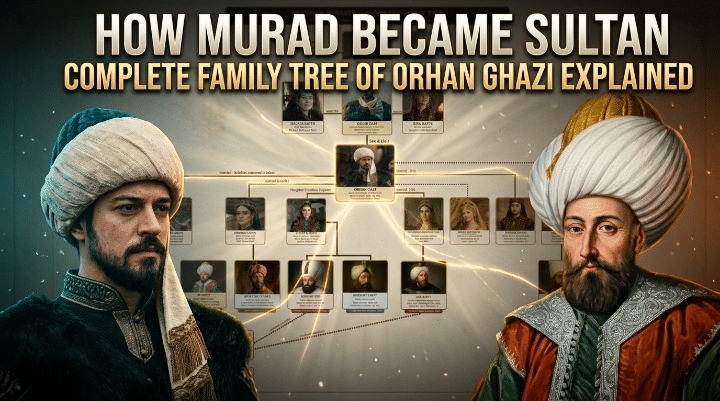
The early history of the Ottoman Empire is filled with powerful leaders, strategic alliances, and brutal decisions. But behind its rise lies a family story unlike any other—one father, seven sons, and only one throne. This is the story of how Murad I emerged as the sole ruler after a series of tragedies, rivalries, and sacrifices. It is not fiction—it is real history shaped by survival, strategy, and the harsh realities of empire-building.
The Foundation: Ertuğrul Gazi
At the top of this powerful lineage stands Ertuğrul, leader of the Kayı Tribe.
He ruled a small nomadic group in Anatolia and laid the foundation for what would later become a global empire. After his death around 1280, leadership passed to his son.
Osman I: Founder of the Empire
That son was Osman I.
Osman transformed a small tribal group into a growing state. Around 1299, he declared independence and began expanding into Byzantine lands. His victory at the Battle of Bapheus marked the beginning of Ottoman recognition as a rising power.
Osman’s marriages also played a key role in strengthening alliances, particularly with Rabia Bala Hatun and Malhun Hatun.
Orhan Gazi: Expansion and Power
The story then moves to Orhan Gazi, who ruled from around 1324 to 1362.
Under Orhan, the Ottoman state expanded dramatically—growing nearly six times its original size. He also became the first Ottoman ruler to formally use the title “Sultan.”
His reign marked a transition from a tribal state to a structured empire.
Orhan’s Strategic Marriages
Orhan Gazi had multiple wives and consorts, and each marriage served a political purpose.
Some of the most notable include:
- Nilüfer Hatun – A Byzantine noblewoman (Holofira) who converted to Islam and became one of the most influential women in Ottoman history.
- Asporça Hatun – Her marriage document from 1323 is one of the oldest surviving Ottoman records.
- Theodora Kantakouzene – Daughter of a Byzantine emperor, who remained Christian after marriage.
- Theodora Uroš – Another political alliance through marriage.
These alliances helped strengthen diplomatic ties across regions.
The Seven Sons of Orhan Gazi
Orhan had seven sons, and each had a unique fate.
Kasım Bey
Son of Nilüfer Hatun. He died of natural causes in 1346 during his father’s lifetime.
Murad I
Also the son of Nilüfer Hatun. He would eventually become the most important figure among the brothers.
Süleyman Pasha
A brilliant military leader who led the first Ottoman expansion into Europe. He died in a tragic hunting accident in 1357.
İbrahim Bey
Son of Asporça Hatun. A capable governor, but ultimately caught in the struggle for power.
Şerefullah Bey
Also the son of Asporça Hatun. His fate remains largely unknown in historical records.
Halil Bey
Son of Theodora Kantakouzene. He was kidnapped as a child by pirates and later rescued, only to face a tragic end.
Sultan Bey
One of the earliest documented sons, but little is known about his life. He died before 1348.
Each son had a different path—but none would share the throne.
The Turning Point: Death of Orhan Gazi
When Orhan Gazi died in 1362, the empire faced a critical moment.
His strongest son, Süleyman Pasha, was already dead. Other sons had either passed away or were still potential claimants to the throne.
At this moment, Murad I stepped forward.
Murad I’s Rise to Power
Murad I quickly secured his position.
To prevent internal conflict and protect the stability of the empire, he ordered the execution of his brothers İbrahim Bey and Halil Bey.
This harsh decision reflected an early Ottoman principle:
one throne, one ruler, no rivals.
While brutal, this policy helped prevent civil war and ensured the empire remained united.
Why Only One Son Survived
Out of seven sons:
- Two died naturally before succession
- One died in an accident
- Two were executed
- One disappeared from records
- Only one became Sultan
That one survivor was Murad I.
The Legacy of Murad I
Murad I went on to expand the Ottoman Empire further into Europe and strengthen its foundations.
The empire he inherited continued to grow, eventually lasting over 600 years and producing 36 sultans, including the conqueror of Constantinople.