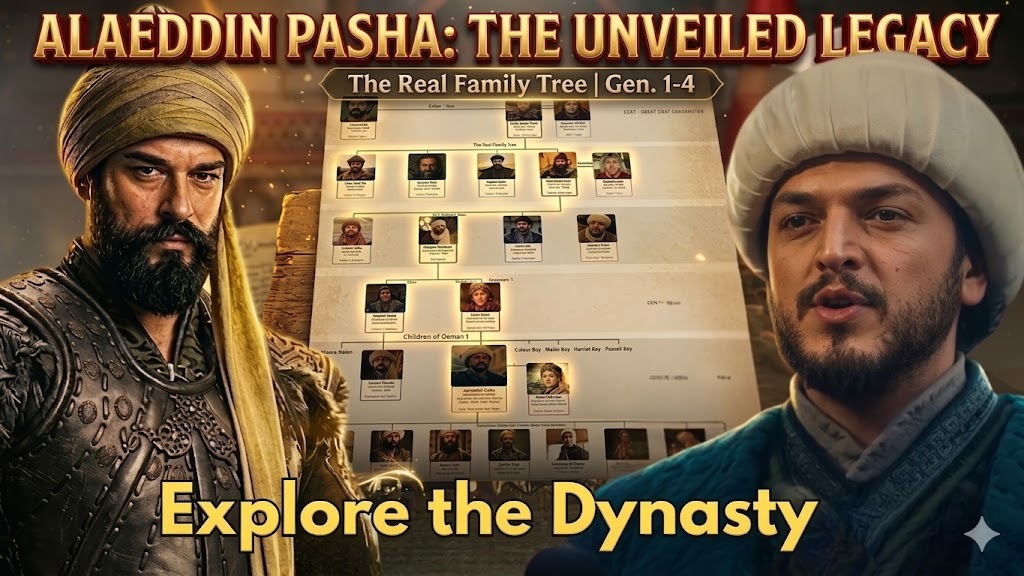
When people think about the early Ottoman Empire, they usually remember famous sultans, epic battles, and dramatic conquests. Names like Osman I and Orhan Gazi dominate the story. But behind the rise of every great empire, someone was managing the system behind the scenes. For the early Ottomans, that person was Alaeddin Pasha — the empire’s first Grand Vizier. While his brother Orhan ruled as sultan, Alaeddin handled administration, governance, and organization during the empire’s earliest years. Despite his importance, his story is rarely discussed. To truly understand his role, we need to look at his family roots and the dynasty that shaped his life. Let’s explore the complete family tree of Alaeddin Pasha, from his ancestors to his descendants.
The Beginning of the Lineage: Suleyman Shah
At the top of the family tree stands Suleyman Shah, Alaeddin Pasha’s great-grandfather.
According to Ottoman tradition, Suleyman Shah was the leader of the Kayı Tribe, a nomadic Turkic group that migrated westward from Central Asia.
Historical tradition says that he drowned while crossing the Euphrates River during a tribal migration.
His wife was Hayme Hatun, who played a significant role in guiding the tribe after his death.
Together they had four sons:
- Ertuğrul
- Gündoğdu
- Sungurtekin
- Dündar
Among these, Ertuğrul would become the most important figure for the future Ottoman dynasty.
Ertuğrul Ghazi: The Frontier Leader
Ertuğrul Ghazi became the leader of the Kayı tribe and entered the service of the Seljuk Sultanate of Rum.
In return for his loyalty, he received control of the frontier town Söğüt, located near Byzantine territory.
This small border settlement would later become the birthplace of the Ottoman state.
Ertuğrul had three sons:
- Osman I
- Savcı Bey
- Gündüz Bey
The first of these sons would go on to establish an empire.
Osman I: Founder of the Ottoman State
Born around 1258, Osman became the leader of the tribe after Ertuğrul’s death around 1281.
From his base in Söğüt, Osman began expanding into Byzantine territory. His victory at the Battle of Bapheus marked one of the earliest major successes of the rising Ottoman state.
Osman had two important wives:
Rabia Bala Hatun
Rabia Bala Hatun was the daughter of Sheikh Edebali, one of the most respected religious leaders in the region.
Through this marriage, Osman gained political and spiritual support.
Their son was Alaeddin Pasha.
Malhun Hatun
Osman’s second wife, Malhun Hatun, gave birth to Orhan Gazi, who would become the first official Ottoman sultan. Osman had eight sons and one daughter, establishing a large ruling family that would shape the empire’s early years.
Alaeddin Pasha: The First Grand Vizier
The central figure of this family tree is Alaeddin Pasha, born around 1281 in Söğüt.
His full name was Alaeddin Erden Ali Pasha.
Historians still debate whether Alaeddin or Orhan was the older brother. Regardless of seniority, Alaeddin stepped aside and allowed Orhan to become the ruler.
Instead of seeking power, he accepted the position of Grand Vizier, effectively becoming the empire’s first chief administrator.
In this role, Alaeddin helped organize early Ottoman institutions, including:
- Administrative governance
- Legal structures
- Military organization
He died in 1331 in Bursa, the early Ottoman capital.
Alaeddin Pasha’s Family
Alaeddin Pasha married the daughter of a Turkish tribal chief named Balad. Unfortunately, her name was not recorded in historical sources — something that was common for women in many medieval chronicles.
Together they had eight children.
Sons
- Kılıç Bey
- Hızır Bey
- Mehmed Bey
- Ibrahim Bey
- Şahi Çelebi
Daughters
- Taci Hatun
- Ayşe Hatun
- Paşa Hatun
These children formed the next generation of the family line.
Alaeddin Pasha’s Grandchildren
The next generation expanded the family further.
Kılıç Bey
The eldest son had several children, and his descendants carried the family line the longest.
Hızır Bey
He also had children and continued another branch of the dynasty.
Mehmed Bey
Mehmed had two children: one son and one daughter.
Ibrahim Bey
Like Mehmed, Ibrahim also had two children — a son and a daughter.
Şahi Çelebi
The youngest son had only one child, a daughter, meaning his branch eventually ended.
Over time, some family branches continued while others gradually disappeared.
The End of the Bloodline
Despite its promising beginnings, the direct line of Alaeddin Pasha eventually faded.
By around 1530, just two centuries after his lifetime, the last known direct descendant had passed away.
While the bloodline ended, Alaeddin’s contributions to the early Ottoman state remained crucial to its success.