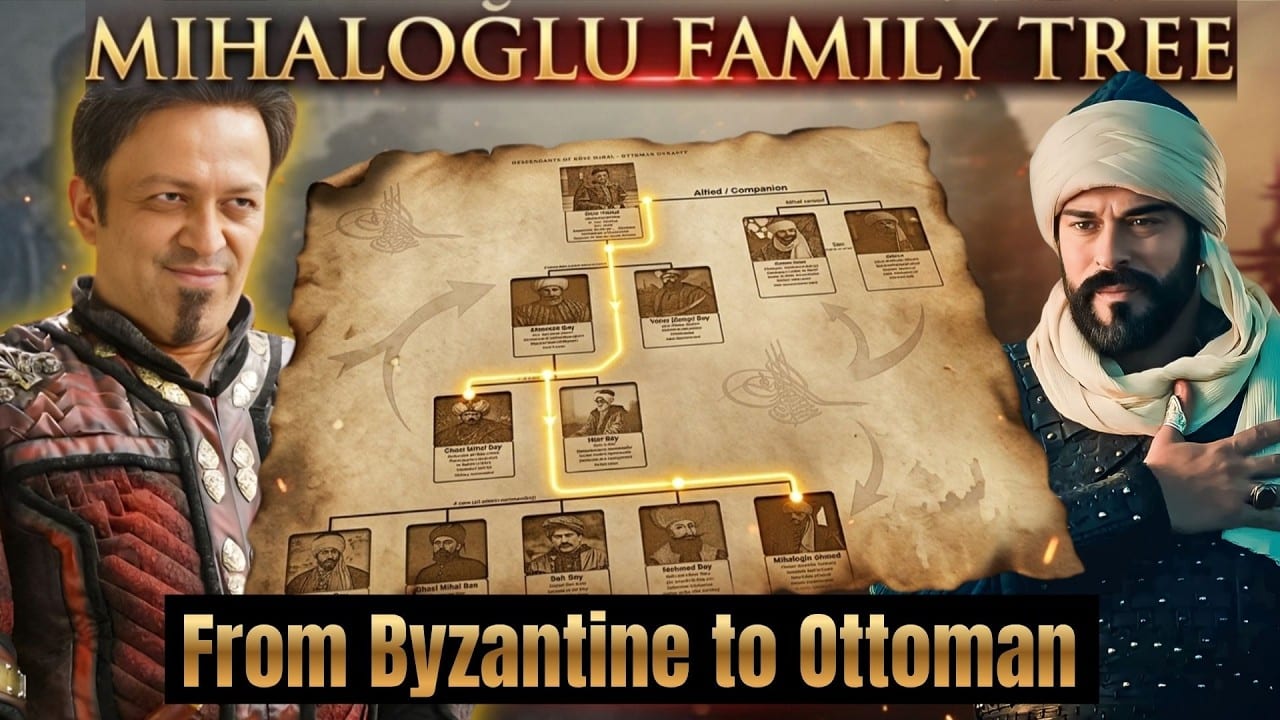
Ottoman history is filled with powerful warriors and influential families, but few stories are as fascinating as that of Köse Mihal. He began his life as a Byzantine Christian governor. Yet after meeting Osman I, his life changed completely. He converted to Islam, joined Osman’s cause, and founded a family dynasty that would serve the Ottoman Empire for nearly two centuries. This family became known as the Mihaloğulları, meaning the sons of Mihal. Over generations, they played a major role in frontier warfare, diplomacy, and Ottoman expansion in Europe.
Who Was Köse Mihal?
Before exploring the family tree, it is important to understand the man who started it all.
Köse Mihal was originally named Michael Kosses, a Greek Byzantine governor who ruled the region of Chirmenkia (modern Harmanköy in Turkey) from Harmankaya Castle.
After converting to Islam, he became known as Abdullah Mihal Gazi.
His nickname “Köse” means “beardless”, a distinctive feature that gave him his popular title.
His Friendship With Osman Gazi
Köse Mihal and Osman Gazi shared a strong relationship built on trust and mutual respect.
A famous story shows this loyalty clearly. Byzantine governors once invited Osman to a wedding, but the event was secretly a trap designed to assassinate him.
Köse Mihal discovered the plot and warned Osman, saving his life.
From that moment on, Mihal became one of Osman’s closest allies, helping guide Ottoman forces through Byzantine territories using his knowledge of roads, castles, and regional politics.
Conversion and Service to the Ottomans
At some point in the early 14th century, Köse Mihal converted to Islam.
Historians debate the reason behind his conversion:
- Some believe it was due to his deep friendship with Osman Gazi.
- Others suggest a spiritual experience or dream led him to convert.
After becoming a Muslim, he continued to serve the Ottoman state not only under Osman but also under Orhan Gazi. He remained active until around the conquest of Bursa in 1326, after which historical records about him become scarce. Köse Mihal likely died around 1340, leaving behind a legacy that shaped Ottoman frontier warfare. Interestingly, his sword is believed to be the oldest surviving Ottoman artifact, preserved today in the Istanbul Military Museum.
The Second Generation: Sons of Köse Mihal
After converting to Islam, Köse Mihal had two sons:
Mehmed Bey
Mehmed Bey played an important role during the Ottoman Interregnum, the civil war that followed the defeat of the Ottomans in the Battle of Ankara.
He also served during the reign of Murad II.
Yahşi Bey
Also known as Bahşi Bey, Yahşi Bey is recorded in historical sources but remains a less prominent figure in the family’s history.
Most of the dynasty’s influence would come through Mehmed Bey’s descendants.
The Third Generation: Rise of the Mihaloğlu Warriors
Mehmed Bey had two sons who continued the family’s military tradition:
- Ghazi Mihal Bey
- Hızır Bey
Ghazi Mihal Bey
Ghazi Mihal Bey became a military commander and built a mosque complex in Edirne in 1422, including a mosque, school, and bathhouse.
For many years, historians mistakenly believed the tomb in Edirne belonged to Köse Mihal himself. Later research showed it actually belonged to Ghazi Mihal Bey.
Hızır Bey
Hızır Bey served as a military commander under Mehmed II.
He died in 1452, but his four sons would become some of the most famous warriors of the dynasty.
The Legendary Generation: Sons of Hızır Bey
This generation includes some of the most celebrated members of the Mihaloğlu family.
Ali Bey Mihaloğlu
Perhaps the most famous member of the dynasty was Ali Bey Mihaloğlu.
Born in 1425, he lived a remarkable life as a frontier commander.
His achievements included:
- Becoming the first Sanjakbey of Smederevo
- Leading the Ottoman Akıncı cavalry raiders
- Conducting major raids into Transylvania and Hungary
One of his most famous campaigns occurred in 1474, when he attacked the city of Várad with 7,000 cavalry.
Despite several victories, he also suffered defeats, including setbacks against Hungarian forces and resistance in Transylvania.
Ali Bey married Maria Craiovești, a Wallachian noblewoman who converted to Islam and became Mahitab Hatun.
Together they had five sons and one daughter.
Iskender Pasha
Also known as Skender Pasha, he served as a military commander under Mehmed II and often fought alongside his brother Ali Bey.
Bali Bey
Known as Ghazi Bali Bey, he earned the title “Gazi,” meaning a warrior of the faith. However, historical sources provide fewer details about his life.
Mehmed Bey
Active during the early 16th century, Mehmed Bey’s exact place in the family tree is debated by historians. Some sources describe him as the son of Hızır Bey, while others believe he was Ali Bey’s son.
The Fourth Generation
Ali Bey Mihaloğlu and Mahitab Hatun had six children:
- Hasan Bey
- Ahmed Bey
- Ghazi Mehmed Bey
- Ghazi Hızır Bey
- Ghazi Kara Mustafa Bey
- Aynişah Hatun
Most of the sons continued the family’s warrior tradition and maintained the Mihaloğlu influence along the Ottoman frontiers.
The Last Powerful Commander: Mihaloğlu Ahmed
One of the final notable members of the dynasty was Mihaloğlu Ahmed, active during the mid-16th century.
He is believed to have been the last family member to hold the hereditary position of Commander of the Akıncı cavalry, the elite frontier raiders of the Ottoman army.
After his time, the family gradually declined in military and political power.
The Mihaloğlu Legacy
Despite their eventual decline, the Mihaloğlu family remained one of the most respected noble dynasties in early Ottoman history.
The famous historian Franz Babinger ranked them alongside other major frontier families such as:
- Evrenosoğulları
- Malkoçoğulları
- Turahanoğulları
- Timurtaşoğulları
Together, these families formed the backbone of Ottoman military expansion in the Balkans.