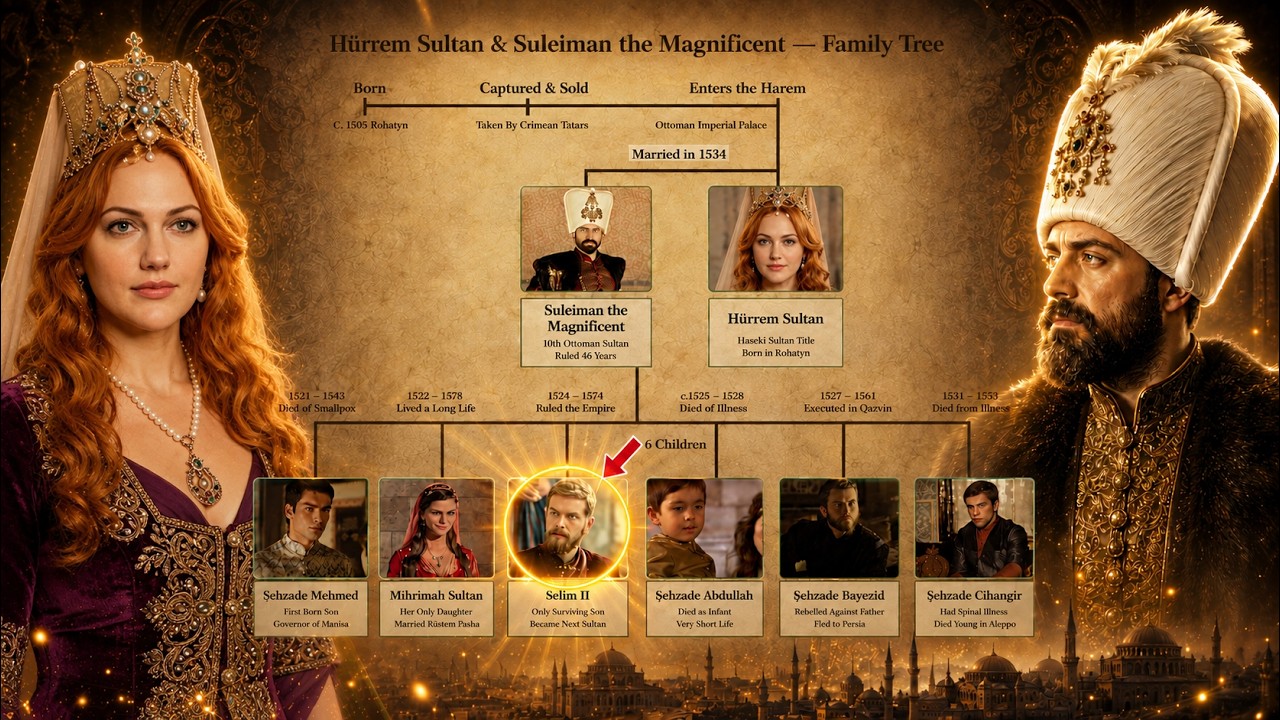
She was kidnapped as a teenager, sold into slavery, brought to Constantinople, and placed inside the Ottoman Imperial Palace. Yet somehow, this young Christian girl would rise to become the beloved wife of Sultan Suleiman the Magnificent and one of the most influential women in Ottoman history. Her name was Hurrem Sultan, better known in Europe as Roxelana. Her rise was extraordinary, but the story of her family was far more tragic. Of her six children with Suleiman, only two would ultimately live long enough to enjoy relatively full lives. One of them, Selim, would inherit the Ottoman throne and establish a bloodline that continued the dynasty for generations.
From Ruthenia to the Ottoman Palace
Hurrem’s story begins around 1505 in Rohatyn, a town that was then part of the Polish-Lithuanian Commonwealth and is now located in Ukraine.
Historians believe she was captured sometime between 1512 and 1520 during a Crimean Tatar slave raid. She was subsequently sold through the Crimean slave trade and eventually brought to Constantinople, modern-day Istanbul.
She was still a teenager when she entered the Ottoman Imperial Palace.
Hurrem was not born Muslim or Turkish. She came from an Eastern Orthodox Christian background in a region historically known as Ruthenia. Her original name remains uncertain. Later writers proposed names such as Aleksandra or Anastasia, but no surviving sixteenth-century document conclusively confirms either.
In Europe, she became known as Roxelana, a name associated with the Roxolani and her Ruthenian origins.
At the Ottoman court, however, she received a completely different identity: Hurrem, a Persian name meaning “joyful” or “cheerful.”
The Woman Who Changed Ottoman Tradition
Hurrem’s rise inside the palace was remarkable.
She eventually became Sultan Suleiman’s favorite companion, but her influence went far beyond the traditional role of a palace concubine.
Suleiman freed her and married her around 1534, breaking with a long-standing Ottoman tradition. Ottoman sultans had generally avoided formal marriage to their enslaved consorts, making Suleiman’s relationship with Hurrem highly unusual.
She also became the first woman to hold the title Haseki Sultan, a position that gave her extraordinary status within the imperial household.
Traditionally, when an Ottoman prince was appointed governor of a province, his mother would accompany him. Hurrem’s position was different. She remained in Constantinople and stayed close to Suleiman.
Her influence extended into politics and diplomacy. She exchanged correspondence with Suleiman while he was away on military campaigns and maintained communication with political figures beyond the Ottoman court.
Hurrem was no longer simply the sultan’s consort. She had become a major political figure in her own right.
The Six Children of Hurrem Sultan and Suleiman
Hurrem and Suleiman had six children: five sons and one daughter. Their lives, however, were marked by illness, rivalry, execution, and tragedy.
Şehzade Mehmed — The Son Who Might Have Become Sultan
Born in 1521, Mehmed was Hurrem’s first son.
He quickly became one of Suleiman’s most promising princes. He was appointed governor of Manisa, a position traditionally associated with preparing Ottoman princes for the throne.
Many believed Mehmed had a strong chance of becoming the next sultan.
But his future ended suddenly.
In 1543, Mehmed died from illness, commonly believed to have been smallpox. Suleiman was devastated by the death of his son.
In his memory, he commissioned the magnificent Şehzade Mosque in Istanbul, one of the most important architectural monuments associated with Suleiman’s reign.
Mihrimah Sultan — The Daughter Who Survived Them All
Born in 1522, Mihrimah was Hurrem’s only daughter.
Unlike her brothers, she survived the dangerous world of Ottoman succession politics.
She married Rüstem Pasha, who later became Grand Vizier. Hurrem supported the marriage, creating an important political alliance around the imperial family.
Mihrimah eventually became one of the most influential Ottoman women of the sixteenth century.
She survived both of her parents and died in 1578, having outlived nearly all of her brothers.
Selim — The Prince Who Became Sultan
Born in 1524, Selim ultimately became the most important of Hurrem’s children.
He served as governor of several important provinces, including Karaman, Manisa, Konya, and Kütahya.
After the deaths of several of his brothers, Selim and Bayezid became the two major contenders for the succession.
Their rivalry would eventually turn violent.
When Suleiman died during a military campaign in 1566, Selim succeeded him and became Selim II.
This was the turning point that transformed Hurrem’s family from one branch of the imperial household into the direct line of Ottoman succession.
Every Ottoman sultan who followed Selim II descended from Hurrem through him.
Selim died in 1574, inside Topkapı Palace.
Abdullah — The Son Who Died Young
Abdullah was born around 1525, but his life was tragically short.
He died as a young child around 1528, most likely from illness.
Unlike his older brothers, Abdullah never reached adulthood and never became involved in the political struggle surrounding the Ottoman succession.
Bayezid — The Prince Who Rebelled Against His Father
Born in 1527, Bayezid became Selim’s greatest rival.
By the 1550s, the Ottoman succession had become increasingly concentrated around the two surviving adult princes. Mehmed and Abdullah were dead, while other members of the family had disappeared from the succession struggle.
Bayezid and Selim developed an intense rivalry.
In 1559, Bayezid openly rebelled against his father.
After being defeated, he fled eastward and sought refuge in Safavid Persia. Suleiman eventually negotiated with Shah Tahmasp to have Bayezid returned.
On September 25, 1561, Bayezid was executed in Qazvin along with several of his sons.
The executions eliminated Bayezid’s descendants as a potential threat to Selim’s succession.
It was one of the darkest chapters in Hurrem’s family history.
Cihangir — The Son Marked by Illness
Cihangir was born in 1531 and suffered from a physical deformity, traditionally described as a spinal condition.
Unlike the princes competing for the throne, Cihangir remained particularly close to his father.
He accompanied Suleiman during military campaigns and was reportedly deeply affected by the death of his half-brother, Şehzade Mustafa, in 1553.
Cihangir died in Aleppo in November 1553, only weeks after Mustafa’s execution.
Later tradition claimed that grief over Mustafa’s death contributed to Cihangir’s death. However, historians examining the available evidence generally point toward his long-term health problems rather than treating the timing as proof that grief caused his death.
How Selim Eventually Took the Ottoman Throne
The road to Selim’s accession was shaped by tragedy.
First, Mehmed died.
Then Abdullah died as a child.
Cihangir died young.
Bayezid eventually challenged his father and was executed along with his sons.
That left Selim as the surviving son of Hurrem with the clearest path to the throne.
When Suleiman died in 1566, Selim became Selim II.
Unlike his father, Selim did not personally lead the empire’s armies in the same way. Instead, much of the day-to-day administration was handled by powerful statesmen, most notably Grand Vizier Sokollu Mehmed Pasha.
But the most important dynastic fact remained unchanged: Selim’s accession ensured that Hurrem’s descendants would continue ruling the Ottoman Empire.
What Happened to Hurrem Sultan?
Hurrem did not live long enough to see her son become sultan.
She died on April 15, 1558, in Constantinople after an illness whose exact nature remains uncertain.
Suleiman was reportedly devastated by her death.
Hurrem was buried in a magnificent domed tomb beside the Süleymaniye Mosque in Istanbul. Eight years later, Suleiman himself died during the Siege of Szigetvár and was buried next to her.
The two were reunited in death after a marriage that had already broken centuries of Ottoman tradition.
The Legacy of Hurrem Sultan
Hurrem’s life was extraordinary not simply because she rose from slavery to become the wife of an Ottoman sultan.
Her greatest historical impact came through the dynasty she left behind.
She entered the Ottoman palace as a teenage slave of uncertain origins. She became the wife of one of the most powerful rulers of the sixteenth century, the first Haseki Sultan, a political correspondent, a patron of architecture and charity, and the mother of the prince who would eventually inherit the empire.
Of her six children, only Mihrimah and Selim lived into old age.
And Selim’s survival changed everything.
When he became Selim II, Hurrem’s descendants inherited the Ottoman throne. From that point onward, the Ottoman dynasty continued through her bloodline for generations.
Her story is therefore not simply the story of a woman who married a sultan.
It is the story of how a teenage captive from Ruthenia entered the Ottoman palace, transformed the imperial household, survived a brutal succession struggle through her descendants, and ultimately became one of the ancestors of the later Ottoman dynasty.
Hurrem Sultan did not inherit an empire. She entered it as a captive — and her bloodline eventually ruled it.