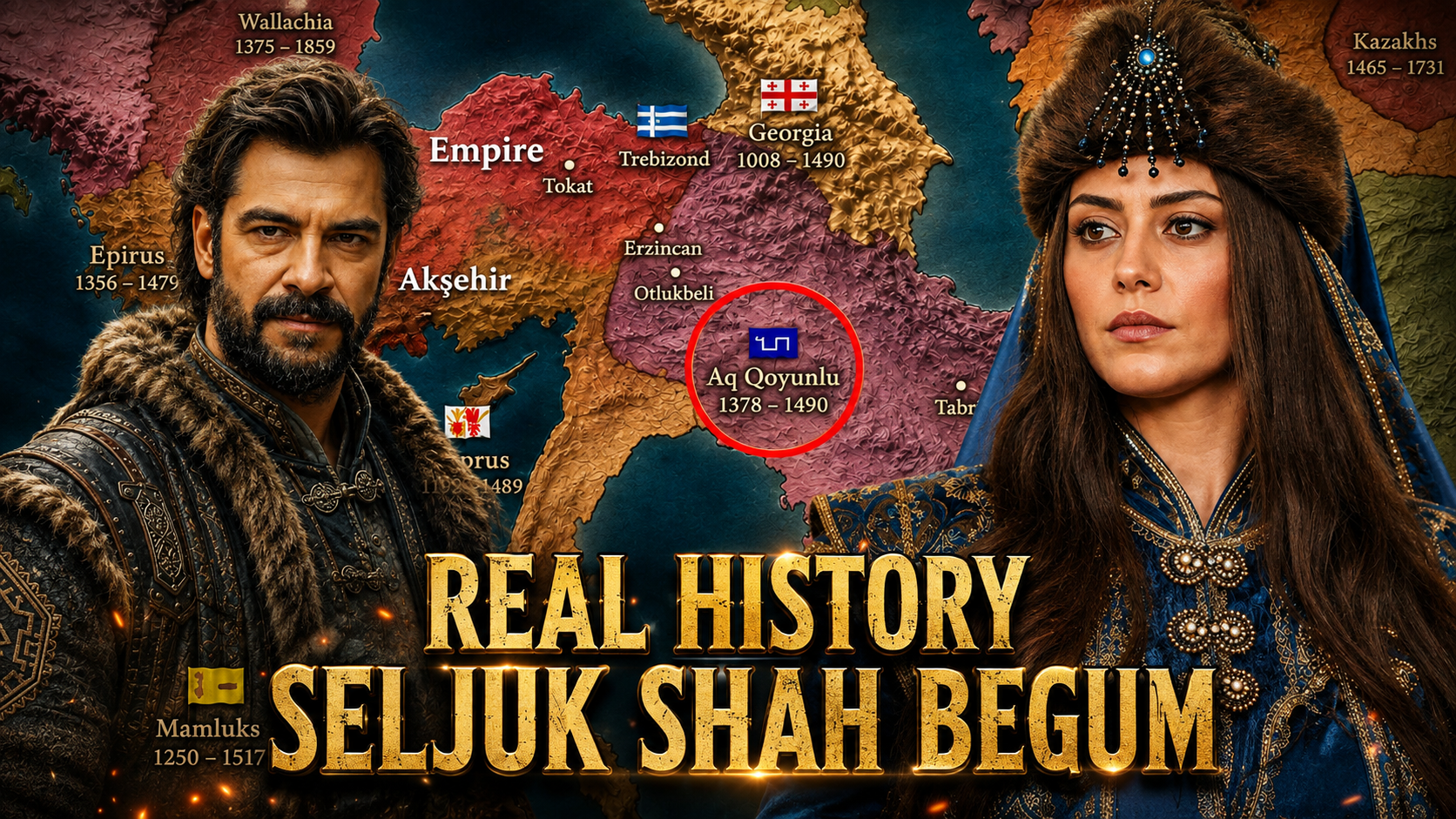
She may have strangled her own husband while he lay sick in bed. Historians have debated the story for centuries, and there is no certainty that it actually happened. But there is little doubt about one thing: Seljuk Shah Begum was one of the most influential women in the Aq Qoyunlu Empire, and her political power reached far beyond the traditional role of a royal wife. In the 15th century, Seljuk Shah Begum stood at the center of the Aq Qoyunlu court, influencing her husband Uzun Hasan, the succession of the empire, and the fate of powerful princes. A modern academic study describes her as an important figure in Aq Qoyunlu political history whose influence extended across the reigns of Uzun Hasan and her sons Sultan Khalil and Sultan Yaqub.
Who Was Seljuk Shah Begum?
Seljuk Shah Begum, also known as Selçukşah Begüm, was the wife of Uzun Hasan, the powerful ruler of the Aq Qoyunlu, or White Sheep Turkmen, dynasty.
She was not simply a queen consort living in the background. Historical sources describe her as a politically active woman who remained at the heart of Aq Qoyunlu affairs for more than three decades. One scholarly study notes that she eventually became known by titles such as Begüm and Mehd-i Ulya, reflecting the extraordinary status she achieved at court.
Uzun Hasan himself became one of the most important rulers of 15th-century Iran and the surrounding region. His state controlled extensive territories, and his rivalry with the Ottoman Sultan Mehmed II eventually culminated in the famous Battle of Otlukbeli in 1473.
Behind much of this political world was Seljuk Shah Begum.
Seljuk Shah Begum and Despina Khatun
Uzun Hasan had several wives, including Despina Khatun, the daughter of Emperor John IV of Trebizond. Their marriage connected the Aq Qoyunlu ruler to the Christian ruling house of Trebizond.
But Seljuk Shah Begum occupied a particularly influential position within the court.
Sources describe tension between the two women, while later historical accounts portray Seljuk Shah Begum as the dominant political figure among Uzun Hasan’s wives.
Her influence was not merely ceremonial.
The TDV İslâm Ansiklopedisi notes that Uzun Hasan increasingly withdrew from state affairs and was strongly influenced by Seljuk Shah Begum. It also states that she helped secure the succession for her son Sultan Khalil.
The Struggle Over the Aq Qoyunlu Succession
The greatest threat to Seljuk Shah Begum’s plans came from Ughurlu Muhammad, one of Uzun Hasan’s sons from another wife.
Ughurlu Muhammad was a talented military commander who gained considerable support among soldiers and nobles. An academic study specifically identifies Seljuk Shah Begum’s political maneuvers as an important factor in the conflict surrounding him.
The succession struggle became especially dangerous because Ughurlu Muhammad had supporters within the Aq Qoyunlu political system.
Seljuk Shah Begum wanted her own son, Khalil, to inherit the throne.
According to historical accounts, she convinced Uzun Hasan that Ughurlu Muhammad was seeking personal glory and claiming credit for military successes. Her influence helped turn father against son.
The result was a political crisis that eventually pushed Ughurlu Muhammad toward the Ottoman Empire.
Ughurlu Muhammad and Mehmed the Conqueror
After falling out with his father, Ughurlu Muhammad sought refuge with Sultan Mehmed II, the Ottoman ruler better known as Mehmed the Conqueror.
Mehmed welcomed him and strengthened the alliance by marrying him to his daughter Gevherhan Hatun. Ughurlu Muhammad was then associated with the governorship of Sivas.
For a time, the Ottoman court provided him with protection.
But Seljuk Shah Begum’s political struggle had not ended.
Historical accounts claim that Ughurlu Muhammad was eventually drawn away from Ottoman protection by misleading promises. He was ambushed near Erzincan and killed in 1477. Some sources explicitly associate Seljuk Shah Begum with the plot against him, although the details vary between accounts.
This episode remains one of the darkest chapters in Seljuk Shah Begum’s story.
Did Seljuk Shah Begum Kill Uzun Hasan?
This is perhaps the most dramatic claim associated with her.
When Ughurlu Muhammad’s severed head was brought to Uzun Hasan, the ruler was reportedly already seriously ill. According to the account preserved by the historian Hasan-i Rumlu, Uzun Hasan said that if he survived his illness, he would take revenge on those responsible for his son’s death.
The story then takes a shocking turn.
Rumlu reported that Seljuk Shah Begum became frightened by Uzun Hasan’s threat and strangled him while he was ill.
However, this should not be presented as an established fact.
The claim comes from a historical tradition rather than conclusive evidence, and modern historians treat the circumstances of Uzun Hasan’s death with caution. What is firmly established is that Uzun Hasan died on 6 January 1478, after a period of serious illness.
So did Seljuk Shah Begum really kill her husband?
We simply cannot say with certainty.
But the fact that such a story was recorded tells us how powerful — and controversial — her reputation had become.
Sultan Khalil Sends His Mother Away
After Uzun Hasan’s death, his son Sultan Khalil succeeded him.
Yet Khalil apparently understood the danger of allowing his politically powerful mother to remain at the center of government.
According to the academic study of Seljuk Shah Begum, one of Khalil’s first actions was to remove his mother and his brother Yaqub from the court and send them away from the capital. The decision appears to have been motivated by his desire to prevent his mother from interfering in state affairs and influencing the succession.
But Khalil’s reign was short.
And after his death, Seljuk Shah Begum’s political career entered an even more powerful phase.
The Rise of Sultan Yaqub
When her other son Sultan Yaqub became ruler, Seljuk Shah Begum returned to the political center.
She was no longer merely the wife of the previous ruler.
She was now the mother of the sultan.
Her position gave her extraordinary authority, and historical sources describe her as a major political force within the Aq Qoyunlu state. The academic literature emphasizes her influence over Sultan Yaqub and the wider court.
This was the era in which her reputation as one of the most powerful women of the Aq Qoyunlu dynasty became firmly established.
Seljuk Shah Begum as a Political Power
Seljuk Shah Begum’s influence went far beyond family politics.
Sources describe her as a woman whose opinions carried considerable weight in government affairs. Her orders could be obeyed by nobles and officials, while major political decisions could depend on her advice and approval.
This makes her particularly important when studying women’s political power in medieval Turkoman states.
She did not officially sit on the throne.
But she could influence who occupied it.
She did not command an army in the traditional sense.
Yet her decisions could determine the fate of princes.
And she did not rule as sultan.
But foreign rulers and diplomats recognized the extraordinary status she held at the Aq Qoyunlu court.
Seljuk Shah Begum and Her Religious Legacy
Seljuk Shah Begum’s story was not entirely about political intrigue.
She was also associated with religious and charitable activities.
Historical research highlights her patronage and religious interests, including her association with Sufi figures and institutions. Her legacy therefore combined political ambition with religious and charitable patronage.
This part of her life is often overshadowed by the stories about succession struggles and alleged murder.
Yet it is essential for understanding the complete historical figure.
How Did Seljuk Shah Begum Die?
Seljuk Shah Begum died in the Karabakh/Arran region around 1490–1491.
Her death is surrounded by competing accounts. One tradition associates her death with an epidemic, while other historical narratives offer a far more dramatic explanation involving poison and the deaths of members of her family.
Because the surviving sources disagree, her final days remain another mystery in her biography.
What is certain is that she died decades after first entering the Aq Qoyunlu political world and after witnessing the reigns of Uzun Hasan, Sultan Khalil and Sultan Yaqub.
Seljuk Shah Begum’s Connection to Ottoman History
Her story is also closely connected to the Ottoman Empire.
The rivalry between Uzun Hasan and Mehmed the Conqueror shaped the politics of the region, eventually producing the Battle of Otlukbeli in 1473. The struggle between the Ottomans and Aq Qoyunlu was not simply a military rivalry; it was also intertwined with dynastic marriages, rebellious princes and competing claims to power.
Ughurlu Muhammad’s relationship with Mehmed II is one of the clearest examples.
The Ottoman ruler welcomed Uzun Hasan’s rebellious son, married him to an Ottoman princess, and gave him an important position. His later death became another episode in the complicated relationship between the Ottoman and Aq Qoyunlu dynasties.
The Real History of Seljuk Shah Begum
The real Seljuk Shah Begum was far more complicated than the image of a simple royal wife.
She was a mother fighting for her son’s succession.
A queen with enormous political influence.
A patron of religious and charitable projects.
A controversial figure accused in historical sources of manipulating events at court.
And, according to one disturbing historical account, perhaps even a woman who killed her own husband.
But separating documented history from later allegations is essential.
Her influence over Uzun Hasan and the succession of Sultan Khalil is well supported by historical scholarship. Her involvement in the downfall of Ughurlu Muhammad is also discussed in historical sources. The claim that she personally strangled Uzun Hasan, however, remains an allegation rather than a proven fact.
That uncertainty actually makes her story even more fascinating.
Why Seljuk Shah Begum Still Matters
Seljuk Shah Begum deserves attention because she represents a side of medieval Turkoman history that is often overlooked.
The story of the Aq Qoyunlu dynasty is usually told through its male rulers — Uzun Hasan, Sultan Khalil, Sultan Yaqub and their rivals.
But Seljuk Shah Begum shows that political power did not always sit openly on the throne.
Sometimes it operated from behind it.
Her story connects Aq Qoyunlu history, Ottoman history, Uzun Hasan, Mehmed the Conqueror, Ughurlu Muhammad, Sultan Khalil and Sultan Yaqub into one extraordinary political drama.
And if modern historical dramas bring these figures to the screen, understanding Seljuk Shah Begum’s real history makes the story even more compelling.