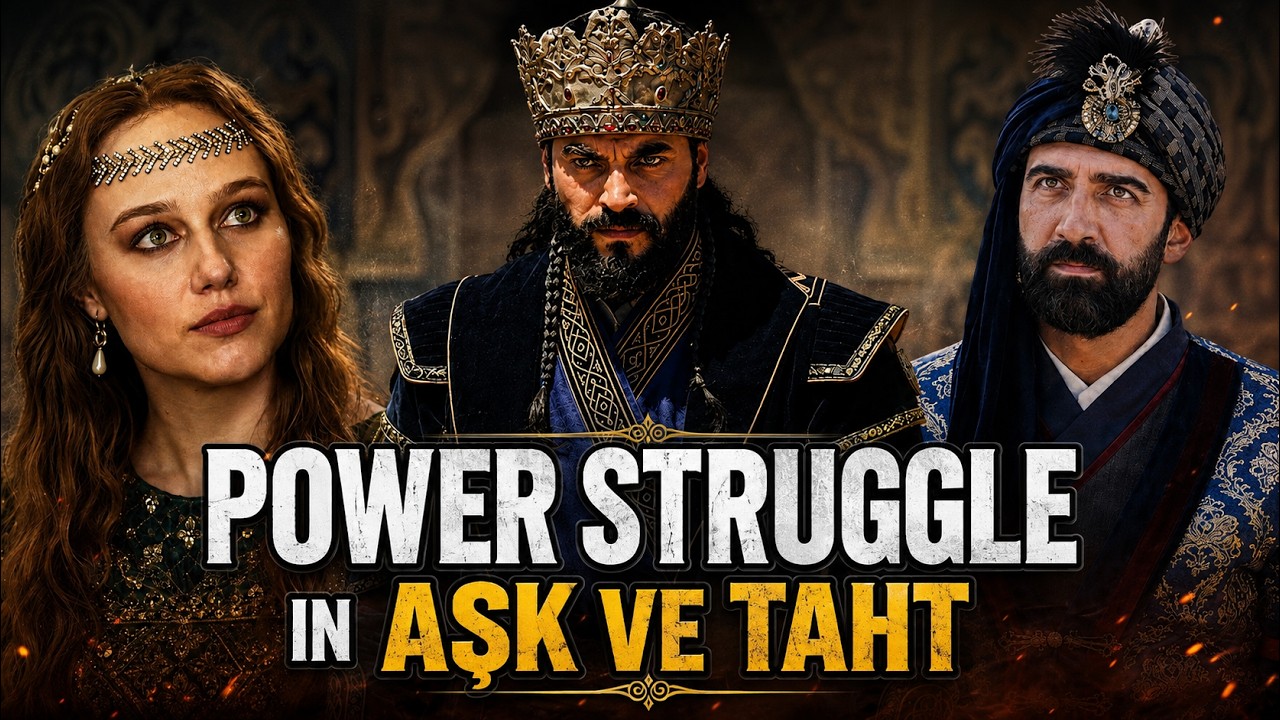
The upcoming Turkish historical drama Aşk ve Taht is already attracting attention with its powerful teaser, introducing a story filled with imprisonment, political ambition, palace intrigue, forbidden love, and the struggle for the Seljuk throne. At the center of the story is Sultan Alaeddin Keykubad, whose journey from a prisoner to the ruler of the Seljuk state provides the series with a dramatic historical foundation. The teaser opens with Alaeddin Keykubad imprisoned for years before an eagle appears outside his cell, symbolizing his eventual freedom and rise to power. But his return to the throne is only the beginning. Rival nobles, harem politics, Byzantine connections, and complicated romances promise to turn Aşk ve Taht into a major historical drama.
Sultan Alaeddin Keykubad’s Real Historical Story
The story of Alaeddin Keykubad begins with his father, Sultan Ghiyaseddin Keyhüsrev, who ruled the Seljuk Sultanate of Rum.
After Ghiyaseddin Keyhüsrev died in 1211, a succession struggle developed between his sons, Izzeddin Keykavus and Alaeddin Keykubad. Keykavus had stronger support in the capital and among the military establishment, leaving Keykubad’s supporters unable to secure the throne.
Keykubad was eventually captured and imprisoned near Malatya.
His years in captivity became an important part of his life. Rather than simply being forgotten, he reportedly used his time to develop his understanding of politics, statecraft, and military strategy.
This period of imprisonment is one of the most dramatic elements adapted by Aşk ve Taht.
From Prisoner to Seljuk Sultan
A major turning point came when Izzeddin Keykavus died around 1220 without leaving a son capable of succeeding him.
The Seljuk political elite needed a powerful ruler who could protect the state from growing external threats, including the expanding Mongol power.
Keykubad was released from captivity and brought into the political center.
He was eventually crowned Sultan of the Seljuk Sultanate of Rum in 1220.
This extraordinary transformation—from imprisoned prince to powerful sultan—is at the heart of the Aşk ve Taht story.
The Eagle Symbol in Aşk ve Taht
One of the most memorable moments in the teaser is the eagle appearing outside Keykubad’s prison cell.
The symbolism is clear.
The eagle represents a man who may have been imprisoned physically but whose ambitions could never truly be contained. When Keykubad later speaks about a caged eagle eventually flying toward the highest peaks, the teaser connects his personal struggle with his rise toward the throne.
The eagle therefore becomes more than a visual detail. It represents freedom, ambition, destiny, and power.
Keykubad’s Return to Konya
After his release, Keykubad travels toward Konya, the political heart of the Seljuk state.
The teaser presents his arrival as a moment of destiny. As he approaches the city’s gates, he reflects on the many sultans who have passed through them before him.
Now, it is his turn.
But Keykubad’s path to power is not completely secure.
A rival nobleman, described as a Malik with his own military force, is also moving toward Konya. His objective is to seize the throne before Keykubad can establish himself.
The rival ultimately arrives too late.
Keykubad already has political and military support, and the crown is already his.
A New Battle Begins Inside the Palace
With the throne secured, the conflict does not end.
Instead, it changes form.
The rival can no longer defeat Keykubad simply through military force, so he begins working through political manipulation and secret schemes.
This creates one of the central conflicts of Aşk ve Taht: the struggle between a newly crowned sultan and powerful figures who refuse to accept his authority.
The teaser suggests that the Seljuk court will become a battlefield where information, alliances, betrayal, and influence can be just as dangerous as swords.
Harem Politics and the Fight for Influence
While the men of the court compete for political authority, another battle is developing inside the palace.
The rival nobleman’s wife reportedly has ambitions of her own. Instead of fighting the sultan directly, she plans to establish influence inside the harem.
Her greatest challenge is the sultan’s mother.
This introduces a second layer of palace politics into the series.
The council represents military and political power, while the harem represents influence operating behind closed doors. Together, these two worlds create a complicated network of alliances and rivalries.
Princess Destina and the Forbidden Love Story
The romantic storyline introduces another major dimension to Aşk ve Taht.
Princess Destina is presented as the daughter of a Byzantine fortress ruler. Her position immediately creates a connection between the Seljuk and Byzantine worlds.
Her comments about anger, responsibility, and the consequences of years of suffering suggest that she understands Keykubad’s transformation in a way few others do.
Even more intriguing is her dream in which she sees herself married to Keykubad—the very man regarded as an enemy by her people.
This creates the possibility of a romance caught between love, politics, religion, and loyalty.
The Mysterious Veiled Woman
Another intriguing mystery appears when Keykubad pursues a mysterious veiled woman.
Earlier, the teaser suggests that the sultan had commissioned a portrait of the woman and ordered his soldiers to find her.
They failed.
Keykubad did not.
The eventual meeting raises questions about her identity and her importance to the sultan’s future.
Could she become another major figure in the palace? Or is her connection to Keykubad part of a larger political plan?
The series appears to be deliberately keeping this mystery hidden.
A Servant Girl Changes the Sultan’s Destiny
Perhaps the biggest romantic twist involves a woman with no royal background.
A servant girl somehow gains access to Keykubad’s private world and eventually captures his heart.
This becomes particularly important because a political marriage could have strengthened the Seljuk state through a royal alliance.
Instead, Keykubad’s personal feelings threaten to disrupt the political plans surrounding him.
His words about destiny placing her in front of him during one of the hardest moments of his life suggest that this romance will become much more than a simple love story.
It could become a direct conflict between the heart and the crown.
Love vs. Power in Aşk ve Taht
This is where the teaser becomes especially interesting.
Keykubad is not simply fighting enemies outside the palace. He is surrounded by people who want to control his decisions.
Nobles want political influence.
The harem wants its own power.
Rivals want the throne.
Political marriages could strengthen the state.
And love threatens to disrupt everything.
As a result, the central question may not simply be who will control the Seljuk throne.
It could be whether genuine love can survive inside a world where almost every relationship has political consequences.
Two Wars Will Shape the Series
Based on the teaser, Aşk ve Taht appears to be building two parallel conflicts.
The War Outside
This is the traditional historical struggle involving armies, rival rulers, military campaigns, political alliances, and the defense of the Seljuk state.
The War Inside
The second battle is far more secretive.
It takes place inside the palace through whispers, jealousy, manipulation, forbidden relationships, and harem rivalries.
That combination could make Aşk ve Taht different from a straightforward historical war drama.