He was raised as a Christian. He fought for Byzantium. He believed the Ottomans killed his father. But one dagger… one symbol… and one sentence from a dying enemy changed everything. In Kuruluş Orhan, Flavius is not just a Byzantine warrior or a romantic subplot. His story is shaping into one of the deepest identity arcs the series has ever attempted—a journey not toward power, but toward truth.
Flavius enters the story as a disciplined, loyal Byzantine commander—cold, controlled, and shaped by empire. Yet from his very first appearance, something feels unusual.
-
His age matches Orhan Bey
-
His bearing feels noble rather than provincial
-
His eyes carry unanswered questions
Flavius doesn’t act like a man who knows who he is. He acts like someone living inside a borrowed identity.
And the key to that mystery is not a person.
It’s an object.
The Dagger That Unlocks the Past
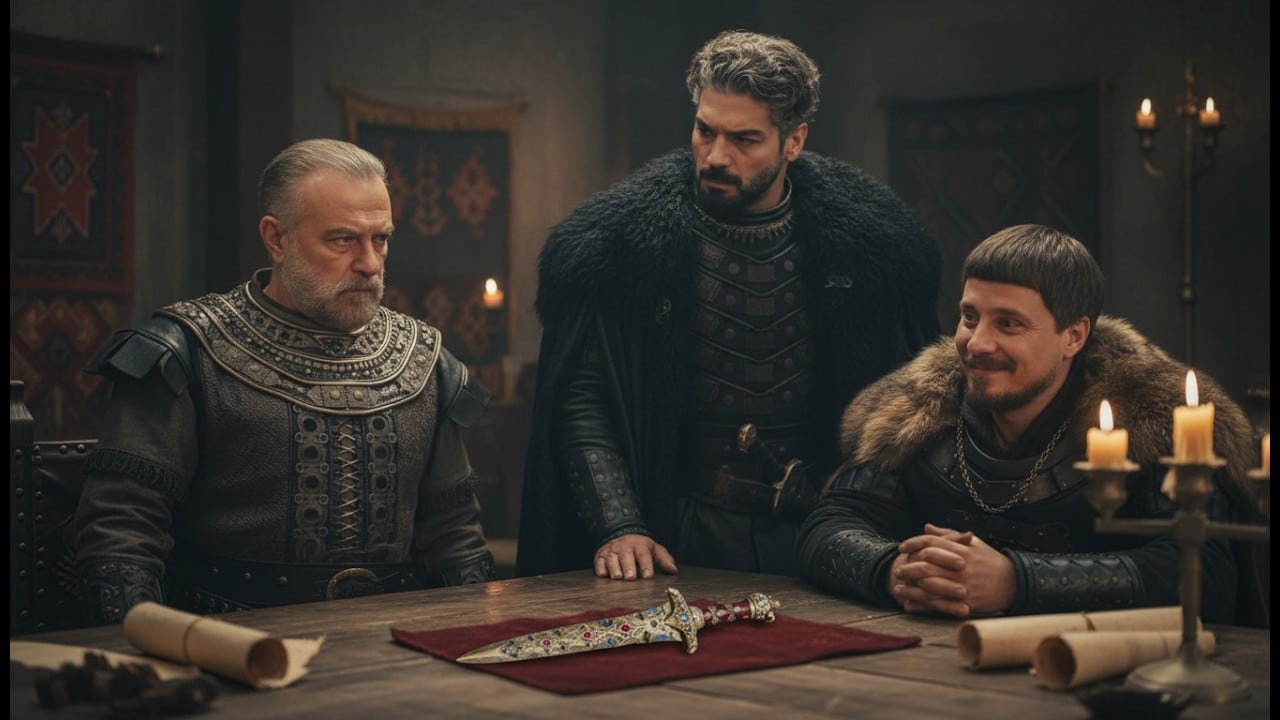
The dagger tied to Flavius is not ordinary.
-
Color: Turquoise (firozi)
-
Symbol: The Taraq Tamga
Turquoise has deep roots in Turkic culture. It symbolizes identity, protection, and lineage. The Taraq Tamga is not Byzantine, Roman, or Christian—it belongs to Turkic dynasties and is most famously associated with Crimean Tatar heritage.
This detail matters.
Because Flavius was told this dagger belonged to his father—not by a friend, but by Saroz.
And Saroz later looks him in the eye and says:
“I will send you to join your father in hell.”
That is not metaphor.
That is a confession.
What We Know for Certain
Some facts are no longer theories:
-
Mozalan was not Flavius’ real father
-
Saroz killed the original owner of the dagger
-
Saroz kept the dagger as a trophy
-
He later gave it to Flavius as mockery
-
Flavius’ true lineage was erased
From that moment, Flavius lived:
-
Under a false name
-
Within a false identity
-
Serving a cause that was never his
Why the Taraq Tamga Changes Everything
The Taraq Tamga is Turkic—specifically tied to Crimean Tatar tradition.
Historically:
-
Crimean Tatars used turquoise as a sacred color
-
Their banners and weapons reflected it
-
Their lineage later intertwined with Ottoman bloodlines
When the series places this symbol on Flavius’ dagger, it is not decorative. It is narrative language.
The message is clear:
Flavius is Turkic by blood.
That leads to one unavoidable question:
Who is his father?
The Four Father Theories — Examined Honestly
Theory 1: Son of Kara Halil (Impossible)
This theory fails immediately.
-
Kara Halil and Orhan Bey are the same age
-
Flavius appears the same age or older
-
A younger father with darker features makes no sense
Narratively and logically, this theory collapses.
Theory 2: Son of Savci Bey (Powerful but Risky)
This is the most emotionally compelling theory.
Savci Bey, Osman’s brother, had a lineage history barely followed.
Possible scenario:
-
Flavius’ real name is Ertuğrul, son of Savci Bey
-
After Savci’s death, the child disappears
-
His mother remarries a Crimean Tatar noble who owns the dagger
-
Saroz kills this man
-
The child is orphaned again and adopted by Mozalan
This explains:
-
The Turkic dagger
-
Saroz’s words
-
Flavius’ noble demeanor
-
His eventual emotional release from hatred
The weakness?
Why Osman never searched for him.
That question still remains heavy.
Theory 3: Son of an Unknown Turkish or Tatar Leader (Most Likely)
This is the most flexible and realistic option.
Flavius could be:
-
The son of a Turkish tribal leader
-
Or a Crimean Tatar noble not yet introduced
The series has done this before:
-
Late flashbacks
-
Mid-story reveals
-
New characters reshaping old truths
This option gives writers freedom without breaking history.
Theory 4: Son of Aygül and Cerkutay (Very Unlikely)
This theory lacks:
-
Historical grounding
-
Symbolic weight
-
Narrative impact
Even strong analysts dismiss it.
Why Flavius’ Story Is Different
Flavius is not defined by romance.
He is defined by rootlessness.
-
No ancestry
-
No inherited identity
-
No prayer that feels like home
If he converts to Islam only for Fatma Hatun, the arc becomes shallow.
But the series is clearly doing something deeper.
Flavius will convert after discovering who he really is.
Not to become someone else—
but to return to himself.
What Is No Longer Speculation
These outcomes are now narrative necessities:
-
Flavius will be revealed as noble-born
-
He will be Turkic by ethnicity
-
Muslim by birth, though raised otherwise
-
Saroz killed his father
-
His hatred toward Osman’s family will dissolve
-
His conversion to Islam will be sincere
-
He will marry Fatma Hatun
-
He will fight beside Orhan Bey
This is not character development.
This is identity restoration.
The Dagger Is Not a Weapon
It is memory.
-
Turquoise → Turkic soul
-
Taraq Tamga → Lost lineage
-
Murder → Erased identity
-
Discovery → Awakening
-
Conversion → Homecoming
Flavius’ journey is not forward.
It is backward—toward who he always was.