

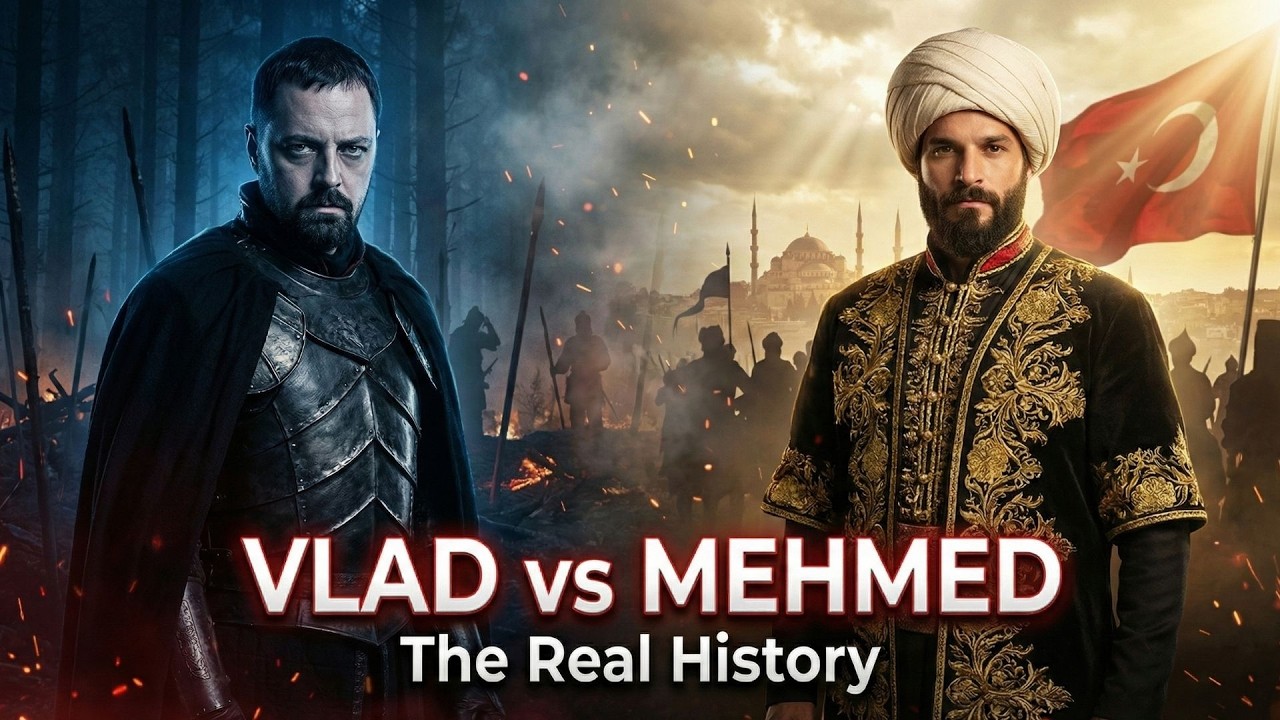
He was raised in the Ottoman court. He learned their language, their discipline, and their tactics. And one day, he turned those same lessons into weapons against them. History remembers him in extremes: a monster, a hero, a tyrant, a defender of Christendom. But the real question is far more unsettling: What transforms a royal hostage into the most feared enemy of an empire? The true story of Vlad III Dracula, also known as Vlad the Impaler, is not just a tale of brutality. It’s a story of captivity, betrayal, identity, and survival—one that eventually led him to challenge even Sultan Mehmed II, the conqueror of Constantinople.
Vlad III’s Early Life: A Prince Raised in Tension
Vlad was born into a dangerous world where thrones were fragile and alliances shifted overnight.
Between 1442 and 1448, Vlad was not a ruler.
He was a hostage.
Why Vlad Was Sent to the Ottoman Court
Vlad and his younger brother Radu were sent to the Ottoman court as political guarantees. Their presence ensured their father’s loyalty to the Ottoman Empire.
In Ottoman lands, Vlad:
-
learned Turkish
-
studied military discipline
-
observed the empire’s efficiency
-
witnessed its brutality up close
He was educated, but he was also controlled.
And he never forgot that.
1447: The Year Vlad’s World Collapsed
While Vlad lived under Ottoman supervision, disaster struck at home.
In 1447, news reached him that shattered his life:
-
his father, Vlad II Dracul, was assassinated by Wallachian boyars
-
his elder brother, Mircea, was captured, tortured, and buried alive at Târgoviște
In a single blow, Vlad lost:
-
his family
-
his safety
-
his inheritance
The boy who entered Ottoman lands as a prince left them emotionally colder and politically sharper.
Wallachia Was Taken Over by Vlad’s Enemies
After the murder of Vlad’s father, the region fell into chaos.
The powerful Hungarian regent John Hunyadi invaded Wallachia and installed his own candidate:
Vladislav II
This meant Vlad’s homeland was no longer his home.
It became occupied territory ruled by the very forces tied to his father’s death.
1448: The Ottomans Release Vlad — Not for Mercy, but Strategy
In 1448, Sultan Murad II made a calculated decision.
He released Vlad.
But this wasn’t kindness.
It was political chess.
Vlad was armed, supplied, and sent north with Ottoman cavalry to reclaim the throne as an Ottoman-aligned ruler.
Vlad’s First Reign (Two Months of Power)
In October 1448, Vlad crossed into Wallachia at just seventeen years old.
His timing was perfect:
-
Vladislav II was away fighting alongside Hunyadi
-
the throne was vulnerable
For a brief moment, Vlad succeeded.
He became Voivode of Wallachia.
But the price of that crown was clear.
He accepted Ottoman authority over the key Danube fortress of Giurgiu, showing that his power depended on the empire that had once held him hostage.
Why Vlad Lost the Throne Quickly
His reign was fragile.
By December 1448:
-
Vladislav II returned with stronger support
-
boyars rallied again
-
Vlad was forced to flee
That short reign changed him forever.
He had tasted power.
And he learned a brutal truth:
Thrones aren’t inherited. They’re fought for.
Vlad’s Years in Exile: The Phase That Rebuilt His Identity
After losing the throne, Vlad entered a long period of exile.
It wasn’t just a political delay.
It was the period that reshaped his alliances and his worldview.
Refuge in Edirne
Vlad first sought refuge in Edirne, inside Ottoman territory.
He remained close to the empire, watching and learning.
But staying there came with a cost:
Dependence.
Vlad needed stronger allies if he wanted real power.
Moldavia and More Betrayal (1451)
By 1449, Vlad moved to Moldavia, where his uncle Bogdan II ruled with Hungarian support.
For a moment, it looked like fate might shift in Vlad’s favor.
Then tragedy struck again.
In 1451, Bogdan II was murdered during a surprise attack.
Vlad fled once more—this time alongside Bogdan’s son:
Stephen the Great
(Who would later become one of the most famous rulers in Eastern Europe.)
Transylvania: The Exiled Prince Nobody Trusted
Vlad escaped into Transylvania, seeking protection in Saxon towns.
But even there, doors were closed.
The city of Brașov initially refused him shelter.
By this point, Vlad had a reputation that made rulers uneasy:
-
shaped by Ottoman influence
-
connected to rival factions
-
unpredictable
In exile, Vlad learned another harsh truth:
Loyalty is never permanent. It’s always political.
The Turning Point: Vlad Aligns with Hungary
Over time, circumstances pushed Vlad toward a decisive shift.
The man who once opposed his family—John Hunyadi—began to see value in him.
Hunyadi needed a frontier ruler who:
-
understood Ottoman tactics
-
could fight like them
-
could anticipate them
Vlad was the perfect candidate.
1456: Vlad’s Transformation Becomes Complete
By 1456, Vlad returned under Hungarian protection.
The former Ottoman-backed prince became a defender of Christian Europe’s borderlands.
The hostage had become a rival.
And the empire that raised him had unknowingly trained its own future nightmare.
Vlad Reclaims Wallachia (1456) — and Rules Through Fear
In 1456, Vlad reclaimed Wallachia with Hungarian support.
He killed his rival and secured the throne.
What followed wasn’t just governance.
It was terror—used as policy.
Vlad’s Revenge Against the Boyars
Vlad targeted the boyars responsible for his family’s destruction.
Some were executed by impalement.
Others were forced to build his mountain fortress at Poenari, working until they died of exhaustion.
How Vlad Created Order
One famous story reflects his method perfectly:
Vlad placed a golden cup in the town square, free for anyone to drink from.
No one dared steal it.
Because in Vlad’s Wallachia, fear created discipline.
The Strange Part: Vlad Still Paid Tribute to Mehmed II
Despite his brutality, Vlad initially maintained a tense peace with the Ottomans.
He still paid tribute to Sultan Mehmed II.
The relationship was uneasy—but stable.
For a time.
1461: Vlad Breaks Tribute and Defies Mehmed II
By 1461, Vlad stopped paying tribute.
He began negotiating secretly with Hungary and grew bolder.
Mehmed II summoned him to Constantinople.
But the summons was a trap.
The Sultan intended to capture him.
Vlad discovered the plan.
And instead of submitting…
He struck first.
The Envoys Incident
Vlad captured Ottoman envoys.
Legend claims that when they refused to remove their turbans, Vlad ordered nails driven into their skulls.
Whether fully true or partly exaggerated, the message was unmistakable:
Vlad had declared war.
1462: Vlad Invades Ottoman Territory
In early 1462, Vlad crossed the Danube into Ottoman lands.
His tactics were ruthless and strategic:
-
villages burned
-
wells poisoned
-
thousands killed
Vlad wrote to European allies claiming:
“I have broken peace with the Sultan for the honor of Christianity.”
The former hostage had become a crusader figure—at least in his own narrative.
But Mehmed II would not tolerate rebellion.
Mehmed II’s Massive Army Marches Into Wallachia
Sultan Mehmed II assembled a huge army, often described as over 150,000 men.
It was one of the largest forces he ever personally commanded.
Vlad knew he could not defeat that army in open battle.
So he used psychological warfare.
The Forest of the Impaled: The Moment That Shocked an Empire
Vlad burned his own lands and destroyed supplies to starve the invading force.
Then came the scene that made him legendary:
The Forest of the Impaled
Thousands of Ottoman prisoners were displayed on stakes outside Târgoviște.
Soldiers. Civilians. Women.
The message was clear:
Turn back… or join them.
Even Mehmed II—hardened by conquest—was shaken by what he saw.
The Night Attack: Vlad Nearly Assassinated Mehmed II
One of the most dramatic events of the entire conflict was Vlad’s daring night assault.
Vlad disguised himself in Ottoman clothing and infiltrated the Sultan’s camp.
Because he spoke fluent Turkish, he moved through chaos giving commands like a real Ottoman officer.
His goal was simple:
Kill Mehmed II
He nearly reached the royal tent.
But darkness, confusion, and misdirection saved the Sultan.
The assassination attempt failed.
But the legend survived.
A former hostage had nearly killed the ruler of the Ottoman Empire.
Vlad’s Downfall: Betrayed by His Own Side
Despite his terrifying tactics, Vlad’s support began to crumble.
His own brother Radu, now loyal to the Ottomans, was sent to replace him.
Many Wallachian nobles defected.
Vlad fled to Hungary for help.
But instead of receiving support…
He was imprisoned.
Thirteen Years in Captivity
Vlad spent around 13 years behind bars.
His former ally, King Matthias Corvinus, accused him of treason using forged letters.
The man who terrified an empire was reduced to a political prisoner.
Vlad’s Final Return and Death (1476)
Vlad was released in 1475.
He returned to fight again.
In late 1476, he reclaimed the throne one last time.
But the reign lasted only months.
Ottoman-backed forces returned.
Vlad was killed in battle near Snagov.
Some accounts claim:
-
he was killed by enemies
-
or his own soldiers mistook him for a Turk in disguise
His severed head was sent to Constantinople and displayed as proof of his death.
The hostage who became a rebel ended as a warning.
Was Vlad a Monster or a Hero?
Vlad’s legacy remains one of the most debated in European history.
To Some, He Was a Tyrant
German pamphlets described him as a demon worse than Nero.
They portrayed him as pure evil.
To Others, He Was a Defender
In Romanian memory, he is often seen as:
-
a strict ruler
-
a defender of the homeland
-
a symbol of resistance
The truth lies in between.
Vlad was brutal.
But he was also strategic.
A ruler shaped by:
-
betrayal
-
captivity
-
endless war
The Ottomans called him: