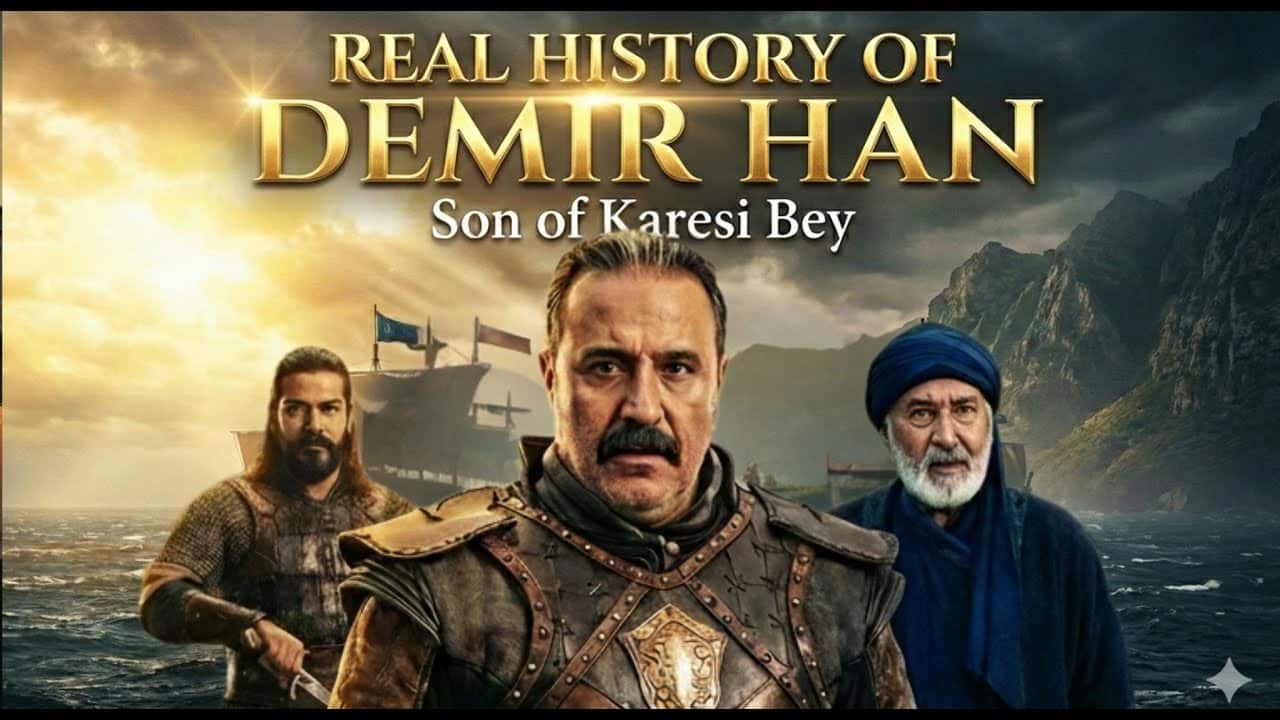
Before Demirhan became a villain on screen, he was already a storm in real history. Not a myth.Not a rumor. He was a real ruler—one whose ambition, naval power, and fatal internal conflict changed the fate of Anatolia forever. Long before the Ottomans crossed into Europe, Demirhan’s choices quietly prepared the ground. This is the forgotten story behind one of Anatolia’s most consequential rulers.
Anatolia After the Seljuks: A Land Divided
In the early 14th century, the Seljuk Sultanate had collapsed. Anatolia fractured into rival Turkish beyliks, each competing for land, trade, and survival. Among them were Germiyan, Aydın, and Saruhan. But one beylik stood apart—not because of land size, but because of the sea. That beylik was Karesi. Stretching across Balıkesir, Bergama, and the Aegean coastline, Karesi was not a small frontier state. It was a maritime power with ships, ports, and influence beyond Anatolia.
Karasi Bey: Founder of a Naval State
The story begins with Karasi Bey. Alongside his father Kalam, he carved territory from Byzantine lands on Anatolia’s northwestern frontier. He established:
-
Balıkesir as his capital
-
Bergama as his western stronghold
Under his rule, Karesi controlled:
-
Trade routes
-
Strategic ports
-
War fleets
-
Coastal raids across the Aegean
By the time of his death around 1328, Karesi was one of the strongest Turkish states in the region. But power brings ambition. And ambition brings blood.
Brothers at War: Demirhan and Yakhshi Khan
After Karasi Bey’s death, his sons divided the realm:
-
Demirhan ruled Balıkesir
-
Yakhshi Khan controlled Bergama
At first, they ruled together.
But unity did not last.
Each wanted full control.
Each raised his own army.
Each prepared for betrayal.
Historians believe Demirhan was the senior ruler. He:
-
Minted his own coins
-
Commanded the main army
-
Controlled the navy
And above all—he was ambitious.
The Treaty That Shocked the Region
Demirhan did something no Turkish bey had dared to do. He signed a treaty with Byzantium. In 1328, the Byzantine emperor personally met Demirhan at Pegai. Two enemies shook hands. Why? Because Demirhan was dangerous.
His ships raided:
-
The Sea of Marmara
-
Byzantine coastal towns
-
Parts of the southern Balkans
Byzantium could not defeat him at sea—so it negotiated.
A Naval Power Ahead of Its Time
Demirhan was not just a land ruler.
He was a naval bey.
His fleet terrorized:
-
Cyzicus
-
Marmara coastlines
-
Christian ports across the region
This made Karesi unique among Turkish beyliks.
And here lies the irony of history:
When the Ottomans absorbed Karesi, they inherited this navy. That naval experience later allowed them to cross into Europe.
Demirhan unknowingly trained the future empire.
A Damning Verdict from Ibn Battuta
In 1333, the famous traveler Ibn Battuta visited Balıkesir—and his judgment was brutal.
He described Demirhan as:
-
Unworthy
-
Disliked by his own people
-
A weak ruler
This reveals a crucial truth.
Demirhan had power—but not loyalty.
And for any ruler, that is fatal.
Civil War Weakens Karesi
While Demirhan dealt with Byzantium, his brother plotted.
The beylik weakened:
-
Armies split
-
Tribes chose sides
-
Cities lost protection
Internal conflict caused more damage than any external enemy.
That was when opportunity appeared.
Orhan Bey Intervenes
Orhan Bey did not attack blindly.
He intervened strategically in the brothers’ conflict.
-
Ottoman forces entered Karesi lands
-
Yakhshi Khan was captured and executed
-
Demirhan’s authority collapsed
By 1345, the Karesi Beylik no longer existed. It became Ottoman territory.
Why the Fall of Karesi Changed History
This was not a small conquest.
It was the first major Turkish beylik absorbed by the Ottomans.
The consequences were enormous:
-
Access to ports
-
Inherited naval power
-
Control of the Aegean coast
-
Preparation for European expansion
From this moment on, the Ottomans stopped being regional rulers. They became an imperial force.
And Demirhan’s civil war opened the door.
Demirhan in Kuruluş Orhan
In the series, Demirhan is portrayed as:
-
Ambitious
-
Proud
-
Divided by power
-
Torn between diplomacy and war
The drama exaggerates personalities—but the core truth remains.
Karesi was destroyed from within.
Not by Orhan’s sword alone.