
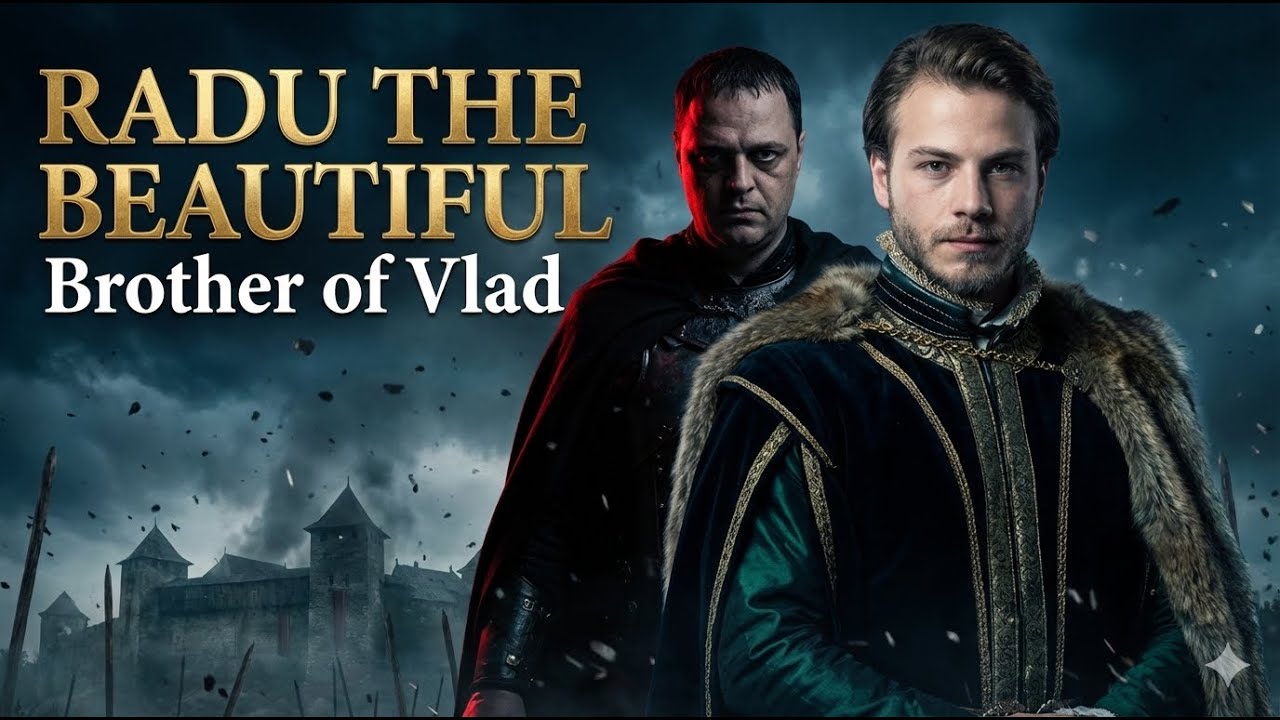
History remembers monsters. But it often forgets men who chose peace. That is exactly what happened to Radu the Handsome. If you’ve seen Mehmed: Fetihler Sultanı, you probably noticed him—calm, soft-spoken, almost overshadowed by louder figures. Yet Radu’s real story is far deeper, more tragic, and far more meaningful than what most adaptations show. This is the story of two brothers raised in the same palace… who chose completely opposite destinies.
Radu was born around 1430 in Wallachia, a land defined by betrayal, shifting alliances, and constant violence.
He belonged to the Drăculești dynasty, a family shaped by ambition and bloodshed.
-
Father: Vlad II Dracul, ruler of Wallachia
-
Brothers:
-
Vlad III, later known as Vlad the Impaler
-
Mircea, whose brutal death would scar the family forever
-
From birth, Radu’s life was inseparable from danger.
Hostages of Empire: Childhood in the Ottoman Court
At just four years old, Radu and Vlad were sent to the Ottoman court.
Not as prisoners—
but as royal hostages, a common medieval political practice.
Their father needed Ottoman support.
The price was his sons.
Inside the palace, the brothers received the same elite education:
-
Arabic, Persian, Turkish, Latin
-
Logic and philosophy
-
Statecraft and military discipline
-
Court etiquette and governance
They lived under the same roof.
But their hearts chose different paths.
The Trauma That Split Two Brothers
When Radu was around ten, devastating news arrived.
-
Their father was killed
-
Their brother Mircea was blinded and buried alive
For Vlad, this trauma turned into rage.
For Radu, it became silent grief.
From that moment on, the brothers stopped walking together—even before they ever left the palace.
Vlad’s Choice: Rule Through Terror
Vlad returned to Wallachia consumed by vengeance.
He ruled through fear:
-
Thousands impaled
-
Terror used as state policy
-
Brutality turned into authority
History would remember him as Vlad the Impaler—the figure who inspired the Dracula legend.
Loud.
Violent.
Impossible to ignore.
Radu’s Choice: Order Over Chaos
Radu chose a completely different path.
He observed Ottoman governance:
-
Law
-
Discipline
-
Stability
He despised chaos and bloodshed. Over time, Radu accepted Islam, not through force, but through conviction.
For him, Islam represented:
-
Structure over madness
-
Order over brutality
-
Identity over revenge
He earned trust within Sultan Mehmed II’s court and became a reliable political figure rather than a weapon of terror.
The Controversial Allegations: Separating Fact From Gossip
Some Byzantine writers later claimed an “unusual closeness” between Radu and Sultan Mehmed.
These claims were repeated for centuries—but here is the truth:
-
No contemporary evidence
-
No official records
-
No credible documentation
Even modern historians agree these were speculative accusations, written decades later by hostile sources.
What likely existed was:
-
Political trust
-
Strategic alliance
-
Courtly familiarity
History must be judged by evidence—not rumor.
1462: Terror Fails, Diplomacy Rises
In 1462, Vlad rebelled against the Ottomans.
Sultan Mehmed marched into Wallachia and encountered horror:
-
Forests of impaled bodies
-
A message written in terror
But fear cannot sustain power forever.
Vlad fled and was later killed in Hungary.
Radu, backed by Ottoman support, was placed on the Wallachian throne.
A Peaceful Ruler in a Brutal Land
Radu ruled Wallachia for over a decade—but never securely.
Why?
Because Wallachia respected fear, not law.
Radu was:
-
Calm
-
Diplomatic
-
Measured
To the local nobility, this looked like weakness.
He was:
-
Removed
-
Restored
-
Removed again
Three times.
Until Basarab III Laiotă finally took power permanently.
A Quiet Death, No Legend
Radu did not die in battle.
He was not executed.
No legend followed him.
Around 1475–1477, his life simply faded away.
No songs.
No myths.
Just silence.
Why History Remembered Vlad—and Forgot Radu
Here is the cruel irony.
-
Radu ruled
-
Vlad terrified
And history chose the one who terrified.
Because history remembers:
-
Noise
-
Blood
-
Fear
Not calm governance.
Radu represents a peaceful path that could not survive a brutal age.
Radu in Mehmed: Fetihler Sultanı
The series portrays:
-
Vlad as a brutal monster
-
Radu as a gentle, restrained figure
This is largely accurate—but incomplete.
Radu was not weak.
He was intelligent and politically aware.
His failure came from:
-
Isolation
-
Lack of local support
-
An unforgiving political climate
Not cowardice.