

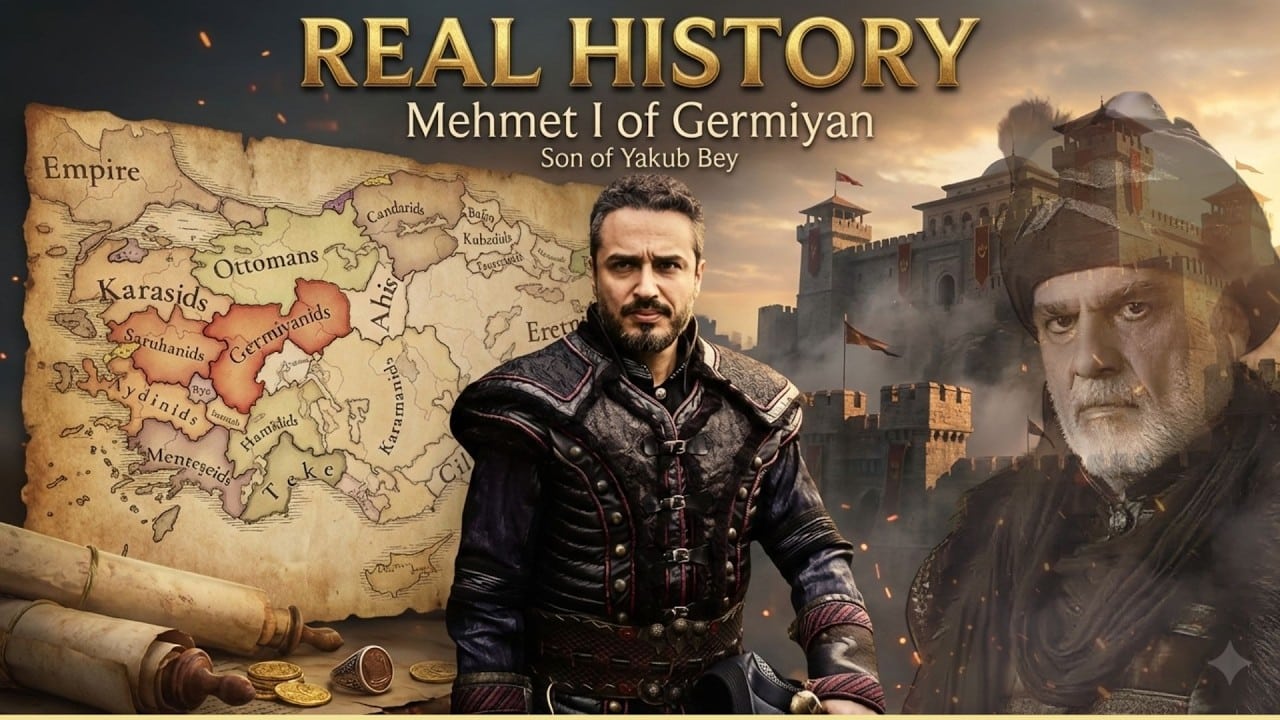
Before the Ottomans ruled Anatolia… before Bursa became a capital… before empires crossed into Europe… There was a ruler who stood in their shadow — not as a conqueror, but as a guardian. He did not build an empire. He prevented one from swallowing his world — for more than two decades. His name was Mehmed Bey of Germiyan.
And history almost forgot him.
Anatolia After the Seljuks: A Land Without One Throne
Early 14th century.
The Seljuk Sultanate had collapsed.
The Mongol grip was weakening.
Anatolia splintered into rival beyliks.
Every ruler faced the same question:
-
Expand…
-
Or survive.
At the heart of western Anatolia, from the stronghold of Kütahya, Mehmed Bey chose survival.
And that decision shaped the region more than most people realize.
Who Was Mehmed Bey of Germiyan?
Mehmed Bey was born around 1298, into a world shaped by migration, raids, and frontier warfare.
His father, Yakub Bey, founded the Germiyanid Beylik — one of the strongest Turkic principalities in western Anatolia.
The Germiyanids were frontier people:
-
Oghuz Turks
-
Hardened by nomadic life
-
Shaped by alliances and survival
Mehmed grew up learning:
-
How to command horsemen
-
How to manage tribal loyalty
-
How to rule without an empire
When Yakub Bey died in 1327, the beylik passed to Mehmed without rebellion and without bloodshed — a rare moment of stability in a violent age.
Mehmed Bey’s World: Surrounded by Rivals
Mehmed’s reign began at a time when Anatolia was burning with competition.
His neighbors were powerful:
-
To the east: Karamanids
-
To the west: Aydınids
-
To the north: Byzantines clinging to survival
-
And rising quietly: the Ottomans
But Mehmed’s first enemy wasn’t Turk or Byzantine.
It was Europe.
The Catalan Company: Mercenaries Turned Invaders
Years earlier, European mercenaries known as the Catalan Company swept through Anatolia.
They were:
-
Hired by Byzantium
-
Then abandoned
-
Then unleashed
They seized towns, raided villages, and carved out territory inside Germiyan lands.
When Mehmed came to power, these mercenaries still held Kula and Simav.
How Mehmed Defeated the Catalans Without a “Big Battle”
Mehmed didn’t rush into reckless confrontation.
Instead, he used patience and pressure:
-
Cut supply routes
-
Harassed garrisons
-
Used terrain as a weapon
-
Avoided costly open-field battles
By the mid-1340s, the Catalans were gone.
No epic siege.
No legendary massacre.
Just quiet victory.
And Germiyan survived.
Why His Coins Matter: Sovereignty in Silver
In medieval Anatolia, power wasn’t only measured in swords.
It was measured in coins.
Under Mehmed Bey, the Germiyanids minted silver akçe bearing his name.
That mattered because it signaled:
-
Sovereignty
-
Economic stability
-
Political legitimacy
From 1341 to 1361, these coins circulated through markets, caravans, and cities.
While other beyliks expanded and collapsed, Mehmed maintained order.
Kütahya Under Germiyan: Culture Without an Empire
Mehmed ruled from Kütahya, and the city became more than a fortress.
It became a center of:
-
Culture
-
Scholarship
-
Poetry
-
Religious legitimacy
Writers and thinkers flourished under Germiyan rule.
There was no massive bureaucracy.
No imperial court.
Just balance:
-
Tribal loyalty
-
Urban administration
-
Religious authority
And for that era, it was enough.
Why Mehmed Didn’t Fight the Ottomans Openly
While Mehmed held the line, the Ottomans were evolving.
They expanded faster.
Built stronger institutions.
Absorbed weaker beyliks.
Mehmed did not fight them directly.
Instead, he maneuvered:
-
Alliances with Karaman
-
Non-aggression with others
-
Avoidance of destructive wars
-
Diplomacy over pride
But history often rewards momentum, not caution.
1361: The End of a Long, Steady Reign
In 1361, Mehmed Bey died.
Not in battle.
Not by assassination.
Just the quiet ending of a long, stabilizing reign.
His son Süleyman Shah succeeded him.
The beylik remained intact — but the world had changed.
Within decades, Germiyan would fall under Ottoman dominance.
Not by conquest alone, but through diplomacy, marriage, and inevitability.
Why Mehmed Bey Matters More Than History Admits
Mehmed I of Germiyan was not a conqueror.
He was something rarer:
A stabilizer.
He:
-
Defended borders
-
Restored lost lands
-
Preserved sovereignty
-
Prevented collapse in a fractured world
And in doing so, he delayed Ottoman expansion longer than most people remember.
History celebrates those who build empires.
But empires only rise because someone else held them back first.