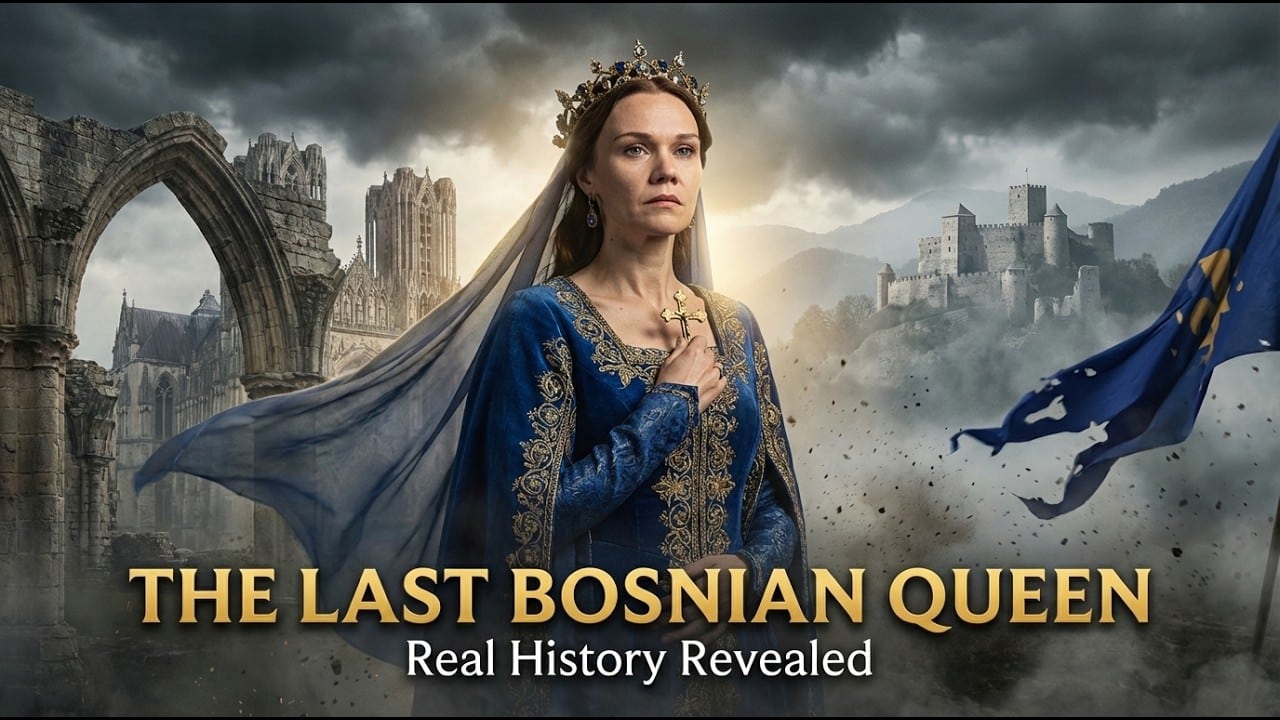
She didn’t just lose a throne. She lost her entire world. Katarina of Bosnia watched her kingdom collapse in a matter of weeks. Her crown was taken almost overnight. Her children were captured and forced into a life she could never reach again. And yet, she refused to disappear. Even in exile, she continued to call herself the Queen of Bosnia, turning her faith, her dignity, and even her final will into a weapon of political resistance. This is the true story of Katarina of Bosnia—a woman whose real-life tragedy is even more intense than any historical drama.
Who Was Katarina of Bosnia?
Katarina was born around 1424 or 1425, in a Bosnia that was anything but peaceful.
Her father was Stefan Vukčić Kosača, one of the most powerful nobles in the region. In fact, his title—Herzog—later inspired the name of the land itself:
Herzegovina
Her mother came from Serbian and Zetan nobility, giving Katarina a bloodline tied to multiple Balkan powers.
From the beginning, she was raised in a world where politics and religion were never separate.
Bosnia’s Religious Divide: The Tension Katarina Grew Up In
During Katarina’s early life, Bosnia was divided into three major religious groups:
-
Catholics
-
Orthodox Christians
-
The Bosnian Church (often branded heretical by Rome)
This wasn’t just a spiritual difference—it shaped alliances, marriages, and wars.
Katarina grew up learning court life, yes… but also learning how to survive in a country where every belief came with political consequences.
A Marriage That Saved Bosnia (Temporarily)
By 1443, Bosnia was unstable and close to internal collapse.
The king at the time, Stefan Tomaš, faced:
-
rebellions inside the kingdom
-
threats from rival nobles
-
rising Ottoman pressure
To gain support, he converted to Catholicism, hoping the Pope would back Bosnia against the Ottomans.
But there was a problem.
He was in conflict with Katarina’s father, and Bosnia was heading toward civil war.
The Solution? Marriage.
In May 1446, Katarina married King Stefan Tomaš in a Catholic ceremony at Milodraž near Fojnica.
This wasn’t a love story.
It was a political peace treaty.
And it worked—at least for a while.
Katarina’s Catholic Faith Was Not Quiet
After the marriage, Katarina didn’t just “convert” to Catholicism.
She became deeply committed.
As queen, she used her wealth and influence to strengthen Catholic institutions across Bosnia.
What Katarina Did as Queen
She:
-
funded church construction
-
supported religious sites in towns like Kupres and Jajce
-
wrote directly to the Pope for religious approval
In 1458, she asked Pope Pius II to dedicate a church in Jajce to Saint Catherine of Alexandria.
The Pope officially responded and even granted indulgences to visitors.
This made Katarina a very visible Catholic figure in a land still divided by faith.
Her Children: The Heirs of Bosnia
Katarina gave birth to two children:
-
Sigismund (born 1449)
-
Katarina (born in the 1450s)
She also had a stepson, Stefan Tomašević, who would later become king.
For a short moment, Bosnia looked stable again.
But the Ottoman threat was already moving closer.
The Death of King Tomaš and the Rise of a Crisis
In 1461, King Stefan Tomaš died.
Katarina became the queen dowager, and her stepson Stefan Tomašević took the throne.
Their relationship had once been tense, but after the king’s death, Stefan publicly accepted her as his mother.
Bosnia needed unity more than ever.
Because Mehmed II was coming.
Mehmed II Invades Bosnia (1463): The Kingdom Falls Fast
In the spring of 1463, Mehmed II launched a brutal invasion of Bosnia.
The campaign was:
-
fast
-
organized
-
devastating
Within weeks:
-
major fortresses fell
-
Bosnia’s defenses collapsed
-
the king was captured
The Execution of Bosnia’s King
King Stefan Tomašević was executed.
Bosnia was officially broken.
The Most Tragic Loss: Katarina’s Children Were Taken
During the invasion, Katarina’s two children were captured and sent to Constantinople.
There, they were converted to Islam.
Her son Sigismund later rose within the Ottoman system.
But to Katarina, they were not “successful.”
They were stolen.
She never saw them again.
Katarina’s Escape: From Castle to the Adriatic
Katarina barely escaped alive.
According to tradition, she fled from Kozograd Castle, traveling through harsh terrain toward the Adriatic coast.
Ships were arranged through Ragusa (modern Dubrovnik).
Two queens survived Bosnia’s fall:
-
Katarina
-
her daughter-in-law, Mara
But Bosnia itself was gone.
Dubrovnik Turned Cold: Politics Replaced Loyalty
Dubrovnik received Katarina carefully.
They feared that sheltering her could trigger Ottoman retaliation.
Katarina attempted to claim royal property and tribute, but the city refused.
This was one of the harsh realities of exile:
Even former allies become cautious when empires threaten them.
Eventually, Katarina left the Balkans completely.
Katarina in Rome: Exile, But Not Defeat
In 1467, Katarina arrived in Rome.
And surprisingly, Rome welcomed her like a queen.
She was given:
-
monthly financial support from the Papal State
-
the respect of religious leaders
-
the ability to maintain a small royal court
Chroniclers even mention an entourage of around forty mounted knights.
She appeared in public ceremonies dressed in black—always dignified, always composed.
Her Life as a Devout Exiled Queen
In Rome, Katarina became closely connected to the Franciscan church of:
Santa Maria in Aracoeli
Some traditions say she joined the Franciscan Third Order, dedicating herself to charity and religious life.
She supported:
-
hospitals
-
the poor
-
religious institutions
But one goal never left her heart:
Freeing her children.
The Queen Who Never Stopped Fighting
Between 1470 and 1474, Katarina sent envoys across Europe.
She reached out to:
-
Milan
-
Christian princes
-
powerful Catholic courts
She begged for help to ransom her children.
In Latin, she described herself as a woman stripped of:
-
her husband
-
her children
-
her kingdom
-
her wealth
At one point, she even considered traveling personally toward the Ottoman border.
But Europe hesitated.
Politics mattered more than a fallen queen’s grief.
Her children remained in Ottoman hands.
Katarina’s Final Will: A Political Masterstroke
On October 20, 1478, Katarina wrote her will.
It was not emotional.
It was strategic.
She declared:
-
If her son Sigismund returned to Christianity, he would inherit Bosnia
-
If her daughter returned to Christianity, she would inherit Bosnia
-
If neither returned…
The kingdom would pass to the Holy See
This was her final act of resistance.
Even after losing everything, she refused to let Bosnia vanish quietly into history.
Her Death and Tomb in Rome
Katarina died on October 25, 1478, just five days after writing her will.
She was buried in Santa Maria in Aracoeli.
Her tomb carried inscriptions in:
-
Bosnian Cyrillic
-
Latin
Even in death, she symbolically bridged cultures.
How Accurate Is the Series Portrayal?
In Mehmed: Fetihler Sultanı, Katarina is shown as a proud and tragic royal figure resisting Ottoman power.
History confirms the key truths:
-
She was the Queen of Bosnia
-
Bosnia fell to Mehmed II
-
Her children were captured and converted
-
She lived and died in exile in Rome
-
She fought diplomatically until the end
The real difference isn’t the story.
It’s the pacing.
History didn’t unfold like an episode.
It unfolded like a slow heartbreak.
Why Katarina of Bosnia Still Matters Today
For centuries, Bosnian Catholics visited her tomb.
Franciscan writers described her as:
-
devout
-
noble
-
saint-like
But today, her legacy is growing beyond one religious community.
Katarina is increasingly seen as a shared historical symbol of Bosnia and Herzegovina:
A queen without a throne.
A mother without her children.
A ruler whose final act preserved her nation’s memory.