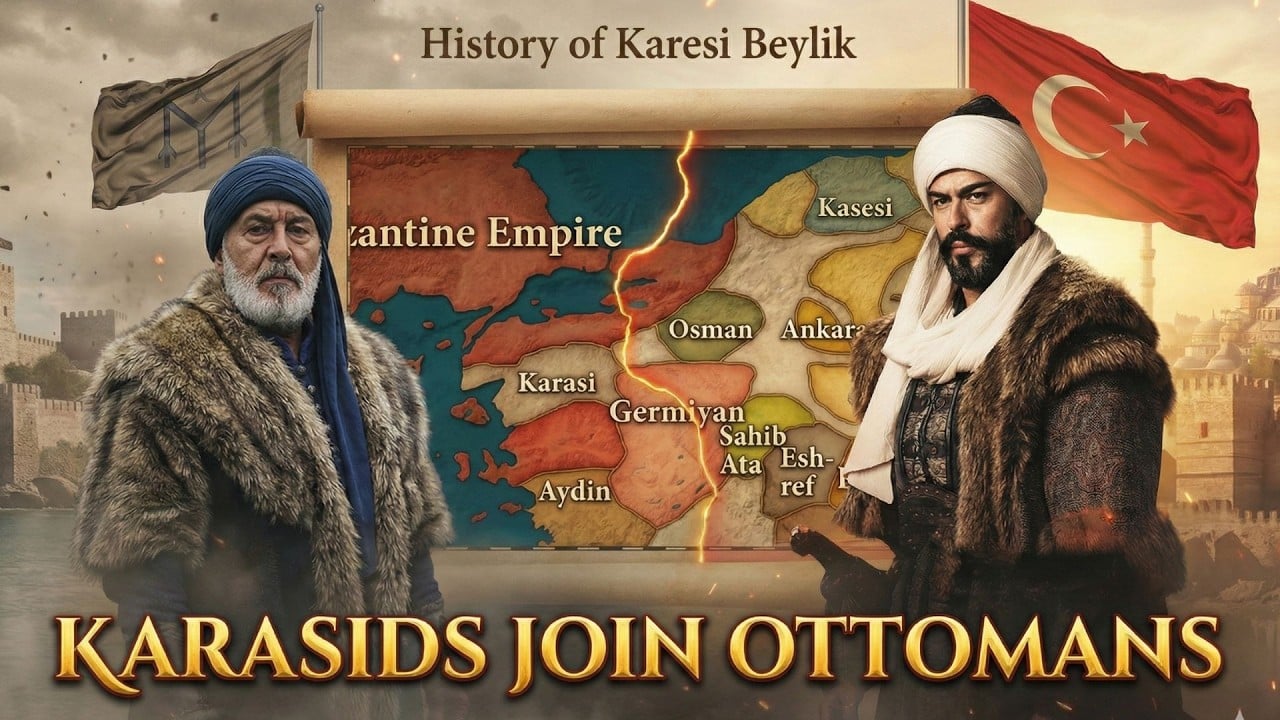
Not every state falls in a single battle. Some collapse slowly. Quietly. From within. Power is divided. Borders weaken. Allies fade away. And then, a stronger neighbor steps in. This is the story of the Karasid Beylik — a once-powerful frontier state on the Aegean coast that became the first major Turkish principality absorbed into the rising Ottoman Empire. Its fall did not just change regional politics. It helped open the path for Ottoman expansion into Europe.
The Rise of the Karasid Beylik
In early 14th-century Anatolia, political unity had vanished. After the weakening of the Seljuk Sultanate following the Mongol victory at Köse Dağ in 1243, many Turkish beyliks emerged across the region. Among them were the Karasids. Founded by Karasi Bey, a Turkmen leader of Oghuz origin, the beylik established control over northwestern Anatolia around 1300. Their core territories included:
-
Balıkesir (inland)
-
Bergama (near the coast)
This region was strategically valuable. Byzantine power in the area had weakened, and the political vacuum created opportunities for ambitious frontier leaders.
Karasi Bey expanded quickly, capturing towns such as:
-
Pergamon
-
Edremit
-
Erdek
Through continuous frontier warfare, his state grew into a formidable coastal power.
A Unique Strength: The Karasid Navy
What made the Karasids different from many other Anatolian beyliks was their early focus on naval strength.
They built light warships in coastal shipyards such as:
-
Edincik
-
Ayvalık
These ships carried out raids across the Aegean, targeting islands like Imbros and Tenedos.
In 1324, Karasi Bey even sent a fleet under Mürsel Bey to assist the Ottomans — one of the earliest recorded Turkish naval operations.
This maritime capability would later become a key asset for Ottoman expansion.
The Turning Point: Division After Karasi Bey’s Death
Karasi Bey died around 1328.
Instead of a unified succession, the beylik was divided between his sons:
-
Demirhan Bey ruled inland Balıkesir
-
Yahshi Han controlled coastal Bergama
This division weakened the state.
Instead of unity, rivalry emerged.
Instead of coordinated defense, competition grew.
Demirhan even sought peace with the Byzantines in 1328 to stabilize his position, showing how internal priorities began to outweigh expansion.
The Karasids were no longer a single, focused power.
Ottoman Patience: Orhan Gazi Waits
By the time Orhan Gazi came to power in 1324, the Ottomans were already rising.
But Orhan did not rush into conflict with the Karasids.
He observed.
He saw:
-
divided leadership
-
weakened military coordination
-
exposed borders
He waited for the right moment.
That moment came around 1345, when Demirhan Bey died, triggering further instability.
The Ottoman Campaign Begins
With the Karasid leadership fractured, Orhan launched his campaign into inland territories.
Ottoman forces were:
-
more organized
-
more disciplined
-
strategically unified
They captured Balıkesir and surrounding areas with relatively limited resistance.
Many Karasid warriors chose to join the Ottomans rather than fight against them, recognizing the growing strength of Orhan’s state.
This marked the beginning of Ottoman control over the inland half of the beylik.
Coastal Absorption Through Diplomacy
The coastal territories under Yahshi Han remained independent for a time.
Rather than wage large-scale naval battles, the Ottomans used a more subtle approach.
Orhan’s son, Süleyman Pasha, strengthened Ottoman influence through:
-
alliances
-
marriage ties
-
political pressure
Gradually, key ports such as:
-
Biga
-
Lapseki
-
Aydıncık
passed into Ottoman control.
Some joined willingly to avoid destruction.
This peaceful transfer was crucial because it gave the Ottomans access to:
-
the Aegean coastline
-
experienced sailors
-
the Karasid fleet
The Final Absorption
By the late 1350s, the Karasid Beylik had become fragmented beyond recovery.
Internal disputes among remaining elites made organized resistance impossible.
Step by step, the Ottomans absorbed:
-
Bergama
-
Çanakkale
-
surrounding coastal territories
By around 1360, the Karasid Beylik ceased to exist as an independent state.
Its lands were now part of the expanding Ottoman realm.
Why the Karasids Fell
The fall of the Karasid Beylik was not sudden.
Several key weaknesses contributed to its decline:
1. Division of Power
Inheritance split authority among heirs, weakening centralized control.
2. Internal Rivalry
Competing brothers undermined unity.
3. Isolation
The beylik lacked strong alliances with neighboring states.
4. Ottoman Organization
Orhan Gazi built a disciplined and structured state, while the Karasids relied heavily on tribal loyalty.
Over roughly sixty years, these weaknesses allowed the Ottomans to gradually absorb their neighbor.
Why This Annexation Changed History
The absorption of the Karasid Beylik was a turning point for the Ottoman state.
It provided:
-
access to the Aegean coast
-
a ready naval force
-
experienced frontier warriors
Most importantly, it opened the route toward Europe.
In 1354, Süleyman Pasha used these maritime resources to cross the Dardanelles and capture Gallipoli.
This became the first permanent Ottoman foothold in Europe.
Without the Karasid merger, this expansion would have been far more difficult.