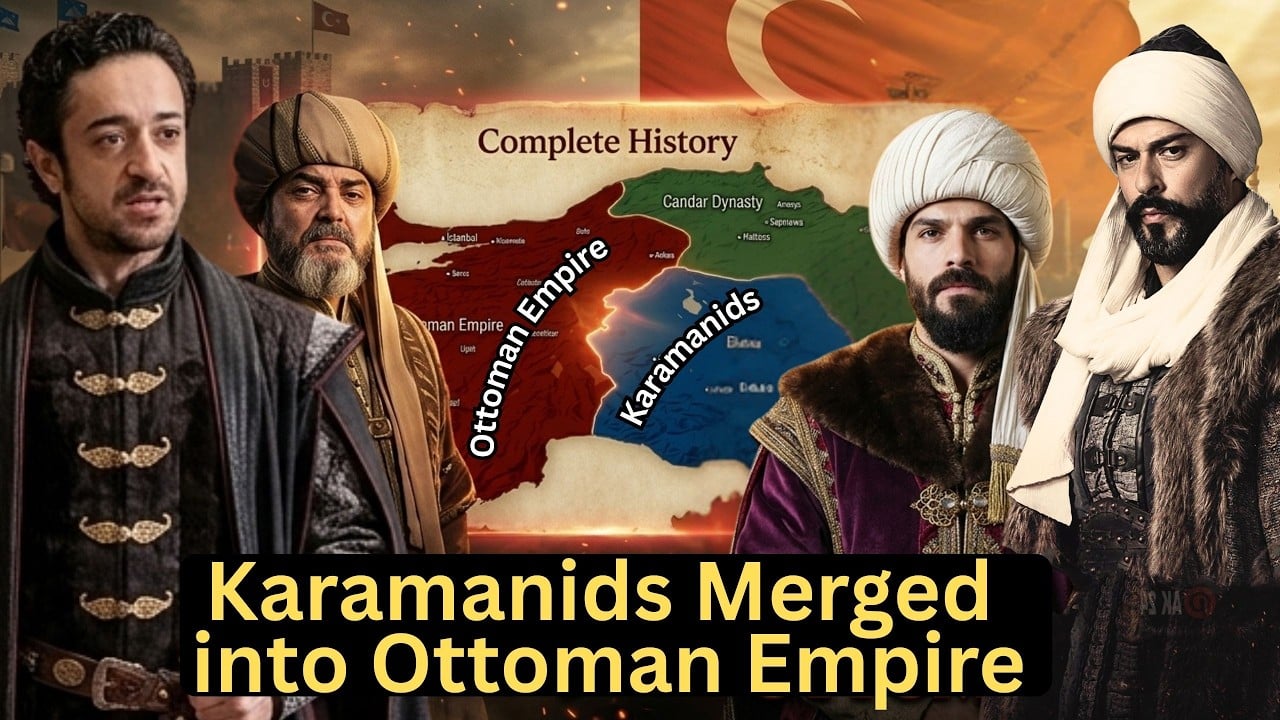
History often remembers empires through their conquests. But sometimes the most fascinating stories are about the rivals who resisted them the longest. For more than two centuries, one Turkish principality challenged the rise of the Ottomans in Anatolia. The Karamanid Beylik. They fought the Ottomans in battle. They betrayed them in politics. They allied with their enemies. Yet by the late 15th century, their powerful state disappeared. To understand how the Karamanids were eventually absorbed into the Ottoman Empire, we must begin with the collapse of an older power that shaped the political map of Anatolia.
The Mongol Shock That Created the Beyliks
The turning point came in 1243 with the Battle of Köse Dağ.
The Seljuk Sultanate of Rum suffered a devastating defeat against the Mongols.
After this battle:
-
Seljuk authority collapsed across Anatolia
-
Sultans became puppet rulers under Mongol control
-
Regional leaders began establishing independent states
These new principalities became known as beyliks.
One of them would become the Karamanid dynasty.
The Rise of the Karamanids
The Karamanid story begins with Nure Sofi, a Turkmen leader who settled near Larende in the Taurus Mountains around 1230.
But the true founder of the state was his son:
Karaman Bey.
Around 1256, Karaman Bey seized control of the region and established an independent beylik.
Their capital became Larende.
From the beginning, the Karamanids expanded aggressively.
They captured key towns such as:
-
Ermenek
-
Mut
-
Ereğli
-
Gülnar
-
Silifke
These mountainous regions provided natural defenses and strong strategic positions.
But the Karamanids had a greater ambition.
They wanted Konya, the symbolic center of Seljuk power.
A Language Revolution in Anatolia
In 1277, the Karamanids achieved a remarkable victory.
Under Mehmed Bey of Karaman, they captured Konya.
There, Mehmed Bey made a historic decision.
At the time, Persian dominated administration and literature in Anatolia.
Mehmed Bey declared that Turkish would become the official language of government.
This became one of the earliest state-level recognitions of Turkish as an administrative language in Anatolia.
However, the victory was short-lived.
Seljuk and Mongol forces soon counterattacked, and in 1278 Mehmed Bey was defeated and executed.
Despite this setback, the Karamanid state survived.
Two Rising Powers: Karamanids and Ottomans
By the early 14th century, the Karamanids were a major power in central Anatolia.
Around the same time, another beylik was rising in the northwest:
The Ottomans, founded by Osman I.
During Osman’s reign, there was little direct conflict between the two powers.
Why?
Because Osman focused primarily on Byzantine territories rather than rival Turkish states.
Ottoman expansion targeted cities like:
-
Bilecik
-
Yarhisar
-
Yenişehir
Meanwhile, the Karamanids expanded in central Anatolia.
Both states grew stronger, and eventually their ambitions would collide.
The Conflict Begins Under Murad I
The real rivalry emerged during the reign of Murad I.
At the same time, the Karamanids were ruled by Alaeddin Ali Bey.
Both leaders had ambitious goals.
Murad I focused on expanding into the Balkans.
Alaeddin Bey sought dominance in Anatolia.
To maintain peace, Murad arranged a diplomatic marriage. His daughter Nefise Hatun married Alaeddin Bey.
But the alliance did not last.
In 1386, Alaeddin attacked Ottoman territory and seized Beyşehir.
Murad responded immediately.
The two sides met at the Battle of Frenkyazısı (1386), where the Ottomans won decisively.
Bayezid I and the First Collapse of Karaman
The conflict intensified under Bayezid I.
Bayezid aimed to unify Anatolia under Ottoman rule.
The Karamanids became his greatest obstacle.
Around 1397, the decisive Battle of Akçay took place.
The Ottoman army crushed Karamanid forces.
Alaeddin Ali Bey was captured and executed.
Konya and surrounding lands were annexed.
For the first time, the Karamanid state collapsed.
Timur Restores the Beylik
But history was not finished.
In 1402, the Central Asian conqueror Timur invaded Anatolia.
At the Battle of Ankara (1402), Timur defeated the Ottomans.
The Ottoman state collapsed into civil war.
Timur restored the Anatolian beyliks, including the Karamanids.
A Karamanid ruler named Mehmed Bey returned to power.
For a brief period, Ottoman dominance in Anatolia disappeared.
Renewed Rivalry in the 15th Century
When Mehmed I restored Ottoman unity in 1413, the rivalry resumed.
Under Murad II, the Karamanids continued attacking Ottoman territories.
During the Crusade of Varna (1443–1444), Karamanid ruler Ibrahim Bey attacked Ottoman lands from behind.
Ottoman historians viewed this as betrayal.
Murad II retaliated after defeating the crusaders.
Mehmed II Ends Karamanid Independence
The final destruction of the Karamanids came under Mehmed II.
After conquering Constantinople in 1453, Mehmed focused on unifying Anatolia.
When Karamanid ruler Ibrahim Bey died in 1464, his sons began fighting each other.
Mehmed exploited the conflict.
In 1468, Ottoman forces captured:
-
Konya
-
Larende
Karamanid independence effectively ended.
The Last Resistance
Resistance continued briefly with support from Uzun Hasan.
However, in 1473 the Ottomans defeated Uzun Hasan at the Battle of Otlukbeli.
This ended any serious external support for the Karamanids.
The final rebellions were crushed by Bayezid II.
By 1487, the Karamanid state had completely disappeared.
Ottoman Policy After the Conquest
The Ottomans did more than conquer territory.
They dismantled the Karamanid social structure.
Mehmed II implemented the Sürgün policy, relocating entire populations to:
-
Istanbul
-
Edirne
-
Bursa
-
Balkan territories
This relocation prevented future rebellions by breaking tribal power networks.
Karamanid elites were absorbed into Ottoman administration.
Over generations, their separate political identity faded.