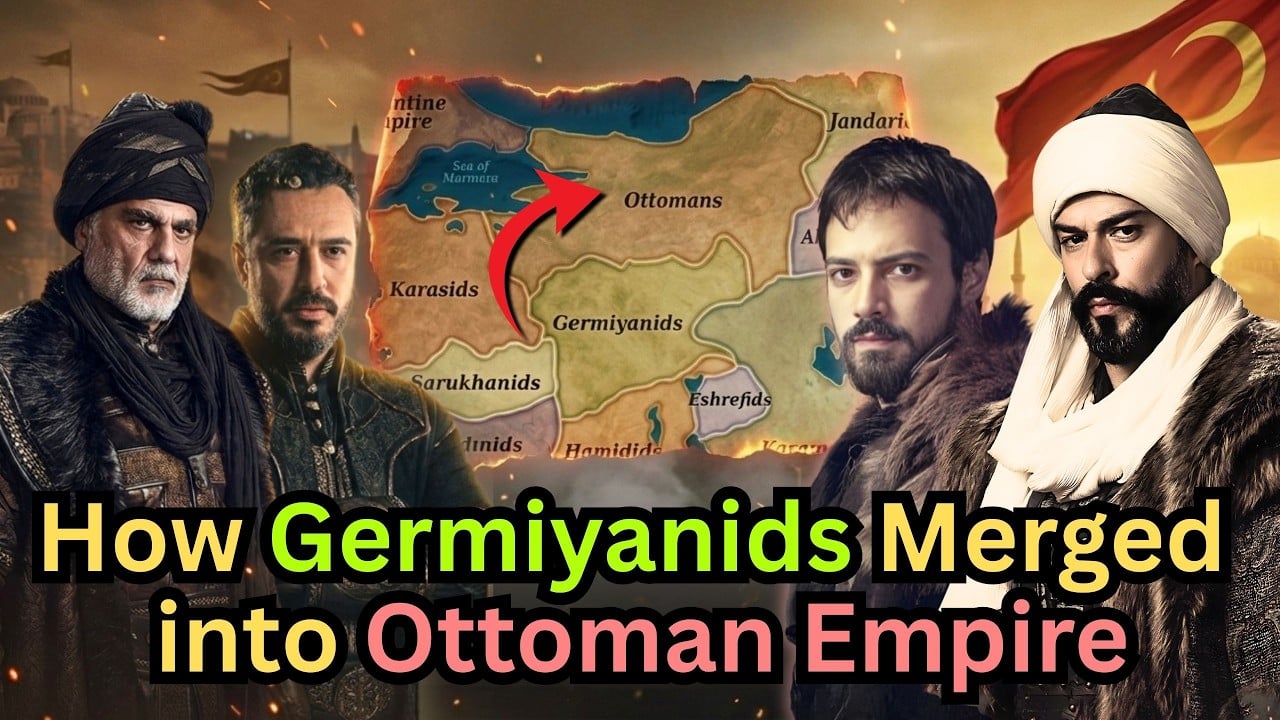
Empires usually expand through war. Through sieges. Through burning cities and fallen fortresses. But one powerful Turkish beylik did something almost unthinkable. It gave away its own capital — as a wedding gift. No invasion. No siege. No battlefield. Just a royal marriage… and half a kingdom changed hands. This is the remarkable story of how the Germiyanids did not fall suddenly to the Ottomans — they slowly merged into them, beginning with a single dowry that reshaped western Anatolia forever.
Anatolia After the Seljuks: A Land of Beyliks
In the early 14th century, Anatolia was fragmented.
After the Seljuk Sultanate was weakened by the Mongol victory at the Battle of Köse Dağ in 1243, central authority collapsed. In its place rose multiple Turkish principalities known as beyliks.
Each beylik fought for survival.
Each ruler dreamed of dominance.
Among the strongest of them stood the Germiyanids.
The Rise of the Germiyanids
The Germiyanids were a powerful Turkmen dynasty of Oghuz origin. After Mongol pressure destabilized central Anatolia, Germiyan tribes migrated west and settled around Kütahya.
By the late 13th century:
-
They had asserted autonomy.
-
They gradually broke from Seljuk-Mongol control.
-
They established a strong regional state around 1300.
Under Yakub I, Germiyan became one of the most powerful forces in western Anatolia. Their capital, Kütahya, was prosperous and strategically vital.
Some historical accounts even suggest that nearby Byzantine territories paid tribute to them.
At this stage, the Germiyanids were not a minor frontier power. They were serious contenders in Anatolia’s political landscape.
Rivals on All Sides
However, Anatolia was crowded with ambitious neighbors:
-
The Karamanids in central Anatolia
-
The Aydınids in the west
-
The Byzantines along the coast
-
And the fast-rising Ottomans in the northwest
At first, relations between the Germiyanids and the Ottomans were tense. Competition and suspicion defined their early interactions.
But politics in Anatolia was never static.
And survival sometimes required unexpected decisions.
Suleiman Shah’s Political Gamble
By the late 14th century, the Germiyan ruler Suleiman Shah faced growing threats, especially from the Karamanids.
Pressure from the south increased. The political balance was shifting.
Meanwhile, the Ottomans under Sultan Murad I were becoming the dominant power in the region.
Suleiman Shah needed protection.
So he made a bold move.
He offered his daughter, Devletşah Hatun, in marriage to the Ottoman prince Bayezid.
This was not simply a wedding.
It was diplomacy.
The 1381 Marriage That Changed Anatolia
In 1381, the marriage took place.
But the real shock was the dowry.
Suleiman Shah gave the Ottomans major territories as part of the marriage agreement, including:
-
Kütahya (the capital)
-
Simav
-
Eğrigöz
-
Tavşanlı
This was an enormous territorial transfer.
Without war.
Without siege.
Without bloodshed.
Prince Bayezid became governor of Kütahya. Suleiman Shah moved his own residence to the smaller town of Kula.
A ruling dynasty had effectively handed over its heartland through diplomacy.
This marked the beginning of Germiyan’s gradual merger into the Ottoman state.
Yakub II’s Resistance and Ottoman Annexation
When Suleiman Shah died in 1387, his son Yakub II inherited a weakened beylik.
Much of Germiyan’s strongest territory was already under Ottoman control.
Yakub II wanted to reclaim what was lost.
After Sultan Murad I died in 1389 and Bayezid became sultan, Yakub saw an opportunity. He allied with the Karamanids in defiance of Ottoman authority.
The response was swift.
In 1390, Bayezid I (Yıldırım Bayezid) invaded Germiyan lands.
Yakub II was captured and imprisoned.
The beylik was annexed by force.
For a brief moment, Germiyan independence ended.
Timur’s Intervention and Temporary Restoration
History, however, was not finished.
Yakub II later escaped and aligned himself with Timur, the powerful Central Asian conqueror who challenged the Ottomans.
At the Battle of Ankara in 1402, Timur defeated Bayezid I.
After the victory, Timur restored Germiyan lands to Yakub II.
Germiyan became independent again — but only temporarily.
This independence was fragile and dependent on larger imperial struggles.
Ottoman Interregnum and Political Survival
After 1402, the Ottoman Empire entered a civil war between Bayezid’s sons, known as the Ottoman Interregnum.
Yakub II played careful politics.
He supported Mehmed Çelebi, who later became Sultan Mehmed I.
This alliance helped Germiyan survive for a time.
But problems continued.
-
The Karamanids captured Kütahya in 1411.
-
The Ottomans later defeated them and restored Yakub II in 1414.
From this point onward, Germiyan functioned more as an Ottoman vassal than an independent power.
Yakub ruled — but under Ottoman dominance.
The Final Decision: A Kingdom Given by Will
By the late 1420s, Yakub II was elderly and had no male heirs.
This created a dangerous succession issue.
If the land passed to distant relatives, it could trigger internal conflict. If divided, rival beyliks might invade.
Yakub made a remarkable choice.
In 1428, he traveled to Bursa, visiting the tombs of Osman I and Orhan Gazi, founders of the Ottoman dynasty. He then went to Edirne to meet Sultan Murad II.
There, he formally declared his will.
He left all Germiyan lands to the Ottoman Sultan.
This was not conquest.
It was political inheritance.
In January 1429, Yakub II died.
With his death, the Germiyan beylik officially became part of the Ottoman Empire.
A Slow Merger, Not a Sudden Fall
The Germiyanids did not collapse overnight.
Their story was a gradual transformation shaped by:
-
Marriage alliances
-
Diplomatic dependency
-
Military defeats
-
Political survival strategies
Instead of endless war, they chose negotiation.
Marriage reduced their territory.
Restoration made them dependent.
A final will completed the merger.
Over nearly fifty years, Germiyan moved from rival power to Ottoman province.