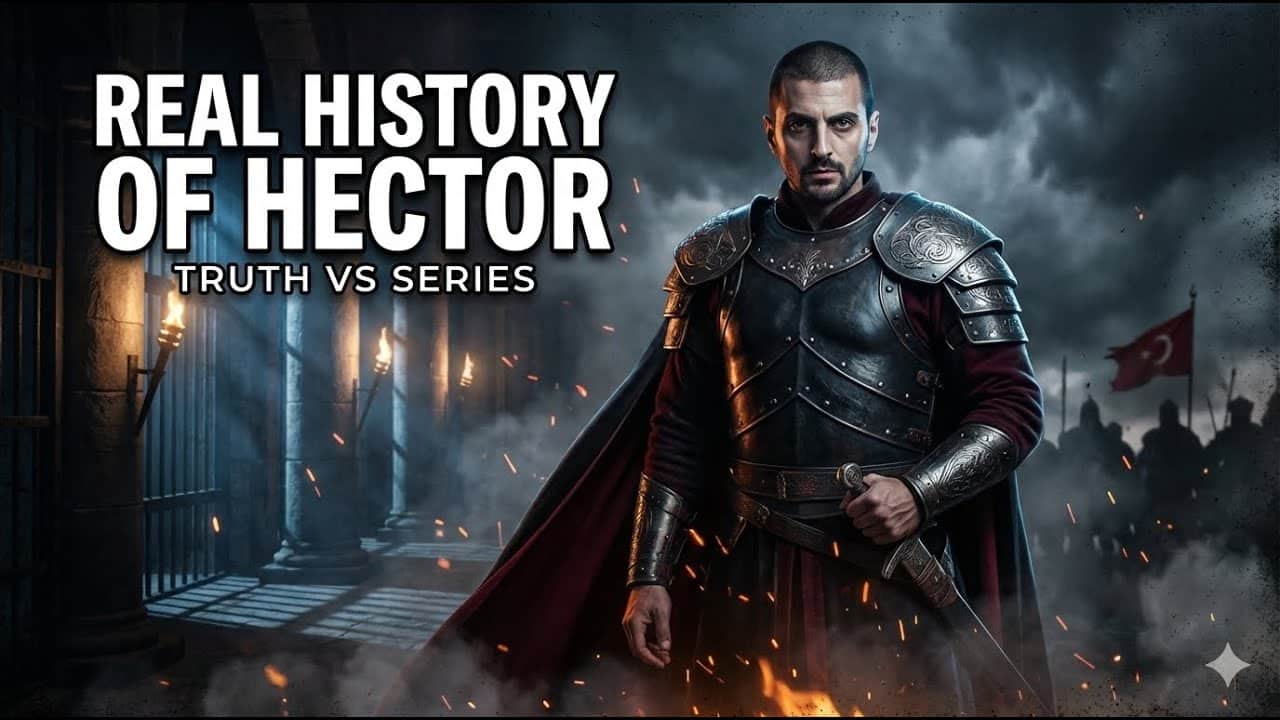
He does not rule a city. He does not wear a crown. Yet emperors tremble when he speaks. In Kuruluş Orhan, few characters inspire as much fear and mystery as Hector. He operates from the shadows, commands powerful forces, and appears capable of bending even emperors to his will. But this raises an important question for viewers who care about history: Was Hector a real person—or a symbolic creation designed to represent something far more dangerous? To answer that, we need to separate historical fact from narrative design.
The Historical Moment: Why Hector Appears Now
The year is 1326.
The Ottomans are no longer a small frontier tribe. They are becoming an empire.
-
Bursa stands on the verge of collapse
-
Byzantine authority is weakening
-
Christian alliances are fragmented and desperate
When empires reach this stage, they don’t rely on governors or diplomacy. They rely on covert power, secret orders, and ruthless commanders. This is where Hector enters the story.
Who Is Hector in Kuruluş Orhan?
In Kuruluş Orhan, Hector is introduced as the leader of the Knights of the Sacred Temple—a secretive, militarized organization operating behind Byzantine authority.
He is not portrayed as a simple battlefield general. Instead, he is shown as:
-
A commander who commands other commanders
-
A man whose influence reaches the Byzantine Emperor himself
-
A shadow ruler working behind official power
At one point, even the Emperor becomes his prisoner. This is not standard Byzantine hierarchy—it is power behind the curtain.
Hector’s Mission: Stop Orhan Bey at Any Cost
Hector’s objective is simple and absolute:
-
Stop Orhan Bey
-
Prevent the conquest of Bursa
-
Crush Ottoman momentum before it becomes irreversible
To do this, he forms a tense alliance with Flavius, the Byzantine commander of Bursa. But their partnership is flawed from the start.
Flavius:
-
Questions Hector’s methods
-
Disobeys direct orders
-
Follows his own instincts
This internal conflict becomes one of Byzantium’s greatest weaknesses. Not Ottoman swords—but Byzantine ego.
The Asporça Operation: Where Everything Breaks
One of Hector’s most critical strategies involves Princess Asporça.
His knights orchestrate her capture, planning to use her as leverage against Orhan Bey. On paper, the plan is cold, calculated, and effective.
But Orhan intervenes.
Asporça is rescued.
And with that single failure:
-
The political balance fractures
-
Byzantine authority weakens further
-
Hector’s control begins to crack
This moment marks the start of the end for Hector’s shadow empire.
Why Hector Feels So Real on Screen
Hector is portrayed by Emre Kızılırmak, a casting choice that immediately stood out to fans of historical dramas.
Viewers recognized him from earlier Seljuk-era roles, known for:
-
Cold intensity
-
Controlled menace
-
Dominating scenes without shouting
This casting was deliberate. Hector feels real because he is played with restraint, discipline, and quiet authority—traits often more frightening than brute force.
The Truth: Was Hector a Real Historical Figure?
No.
There is no historical record of:
-
A knight named Hector
-
A group called the “Knights of the Sacred Temple”
-
A single commander holding the Byzantine Emperor hostage
Hector is a fictional character.
But that does not make him meaningless.
What Hector Actually Represents
Hector is a composite character—a symbol rather than a person.
He represents:
-
Byzantine resistance to Ottoman expansion
-
Catholic military orders and Crusader remnants
-
Mercenary commanders
-
Secret diplomacy and internal power struggles
Historically, Orhan Bey faced:
-
Byzantine tekfurs
-
Crusader-linked forces
-
Fragmented Christian alliances
-
Mercenary leaders with shifting loyalties
Instead of introducing dozens of minor historical figures, the series compresses all these pressures into one man.
Hector is historical pressure personified.
Why Hector Matters to Orhan Bey’s Story
Hector may not be accurate by name, but he is accurate by purpose.
He embodies:
-
The fear Byzantium felt as the Ottomans evolved into empire-builders
-
The resistance of a collapsing world fighting change
-
The final obstacles before Ottoman dominance becomes inevitable
By giving Orhan Bey a single, powerful rival, the series creates a focused narrative conflict—one that reflects real historical tension, even if the character himself never existed.