When looking at Ottoman history, most people focus on sultans and famous battles. However, some of the most influential figures were powerful frontier families who shaped the empire’s expansion. One such family is the dynasty of Gazi Evrenos Bey.For more than a century, the Evrenos family did far more than simply serve the Ottoman Empire— they helped control and stabilize the Balkans. Their story begins with a mysterious origin, grows through military conquest, and eventually becomes a powerful political network that influenced Ottoman rule in Europe.
The Origins: Isa Bey Prangi
Before the famous Evrenos name appeared, there was his father: Isa Bey Prangi.
Historians widely agree that the family was not originally Turkish. Instead, they likely came from a Byzantine or Balkan Christian background before converting to Islam and joining the Ottomans.
Several historians support this theory, including:
- Stanford Shaw
- Joseph von Hammer
- Peter Sugar
- Dimitri Kitsikis
Isa Bey Prangi became one of the early frontier warriors of the Ottoman state. He eventually died in battle near the Evros River, close to modern-day Greece. His death later became symbolic because his son returned to the same location and built a tomb in his honor.
This early story shows a key theme that would define the family: legacy and continuity.
The Rise of Gazi Evrenos Bey
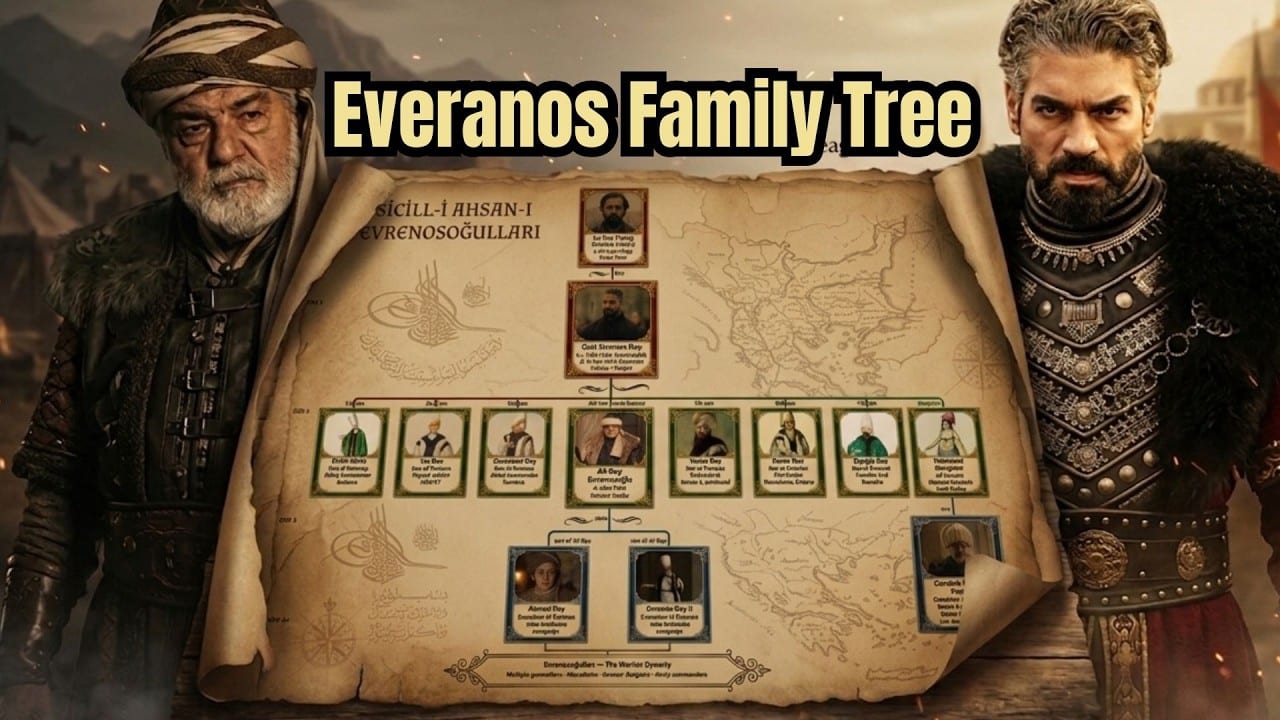
The central figure of the family tree is Gazi Haji Evrenos Bey.
He was likely born between 1288 and 1290 in the Karasi Beylik, a Turkish principality in western Anatolia. Later, he joined the expanding Ottoman Empire under Orhan Gazi.
Evrenos quickly became one of the empire’s most important frontier commanders.
His Military Career
His career followed the Ottoman expansion into Europe:
- Ottoman forces crossed into Europe after Byzantine defenses weakened at Gallipoli.
- Evrenos became part of the early campaigns in the Balkans.
- He participated in the conquest of Adrianople (Edirne) in 1362, which later became the Ottoman capital.
For his success, he was given the powerful role of Uc Bey, meaning a frontier governor responsible for military operations.
Major Battles of Evrenos Bey
Evrenos Bey was present in several defining battles of Balkan history.
Battle of Maritsa (1371)
A smaller Ottoman force launched a surprise night attack on a large Serbian army.
The result was devastating. Serbian power in the region collapsed almost overnight.
Battle of Kosovo (1389)
One of the most famous battles in Balkan history. Evrenos again played a role in the Ottoman victory.
Battle of Nicopolis (1396)
This battle involved a massive European crusader army attempting to stop Ottoman expansion.
The Ottomans defeated the crusaders, securing their dominance in southeastern Europe for generations.
Builder of Cities
Evrenos Bey was not only a conqueror—he was also a builder.
Throughout the Balkans, he helped develop towns and infrastructure.
Cities associated with his influence include:
- Keşan
- İpsala
- Komotini
- Serres
- Monastir
- Corinth
He built mosques, caravanserais, and public kitchens. Many of these structures survived for centuries.
His tomb still stands today in Giannitsa, Greece, the town he founded as Yenice-i Vardar.
The Ottoman Crisis and Evrenos’ Loyalty
In 1402, the Ottomans suffered a massive defeat during the Battle of Ankara against Timur.
The empire collapsed into civil war known as the Ottoman Interregnum.
During this unstable period, Evrenos remained a key supporter of Mehmed I, who eventually reunited the empire.
Without commanders like Evrenos holding the Balkan territories together, the Ottomans might have lost their European lands entirely.
The Second Generation: Seven Sons
When Evrenos died in 1417, he left behind seven sons who continued the family legacy.
They included:
- Khidr-Shah – A frontier cavalry commander.
- Isa Bey – Known for a historical document that reveals clues about the family’s origins.
- Suleyman Bey – Maintained the family’s lands during political struggles.
- Yakub Bey – Involved in the Ottoman succession conflicts.
- Barak Bey – Another active frontier leader.
- Begdje Bey – Continued serving as a military commander.
- Ali Bey Evrenosoğlu – The most important successor.
The family also had a daughter who married Çandarlı Halil Pasha.
Their son became Çandarlı Ibrahim Pasha, showing how the family gained influence in both military and political spheres.
Ali Bey Evrenosoğlu: The Next Great Leader
Among the sons, Ali Bey Evrenosoğlu carried forward the family legacy most prominently.
He became the commander of the Akinji, elite Ottoman raiders known for fast and aggressive cavalry attacks.
Important Campaigns
Ali Bey participated in several major campaigns:
- The siege of Thessaloniki in 1430
- Raids into Albania during the 1430s
- Reconnaissance missions into Hungary
However, he also faced setbacks, including defeat at Belgrade in 1441 against John Hunyadi.
He also fought repeatedly against the famous Albanian resistance leader Skanderbeg.
The Third Generation
Ali Bey later brought his own sons into military campaigns.
Two important figures of the third generation were:
- Ahmed Bey
- Evrenos Bey II
Both served as Akinji commanders and continued the military tradition of the family.
The Evrenosoğulları Legacy
Over time, the family became known as the Evrenosoğulları—the Sons of Evrenos.
They were one of the four great Ottoman frontier families, alongside:
- Mihaloğulları
- Malkoçoğulları
- Turahanoğulları
Interestingly, many of these powerful frontier families also came from Balkan or Byzantine backgrounds.
Together, they formed the backbone of Ottoman expansion in Europe.
Why the Legend of Evrenos Grew So Large
Some stories claim Evrenos lived for more than 120 years.
While historians debate this, the legend likely grew because his name remained powerful for generations.
His sons, grandsons, and descendants continued using his reputation to maintain influence across the Balkans.
Over time, people stopped separating the man from the dynasty he created.