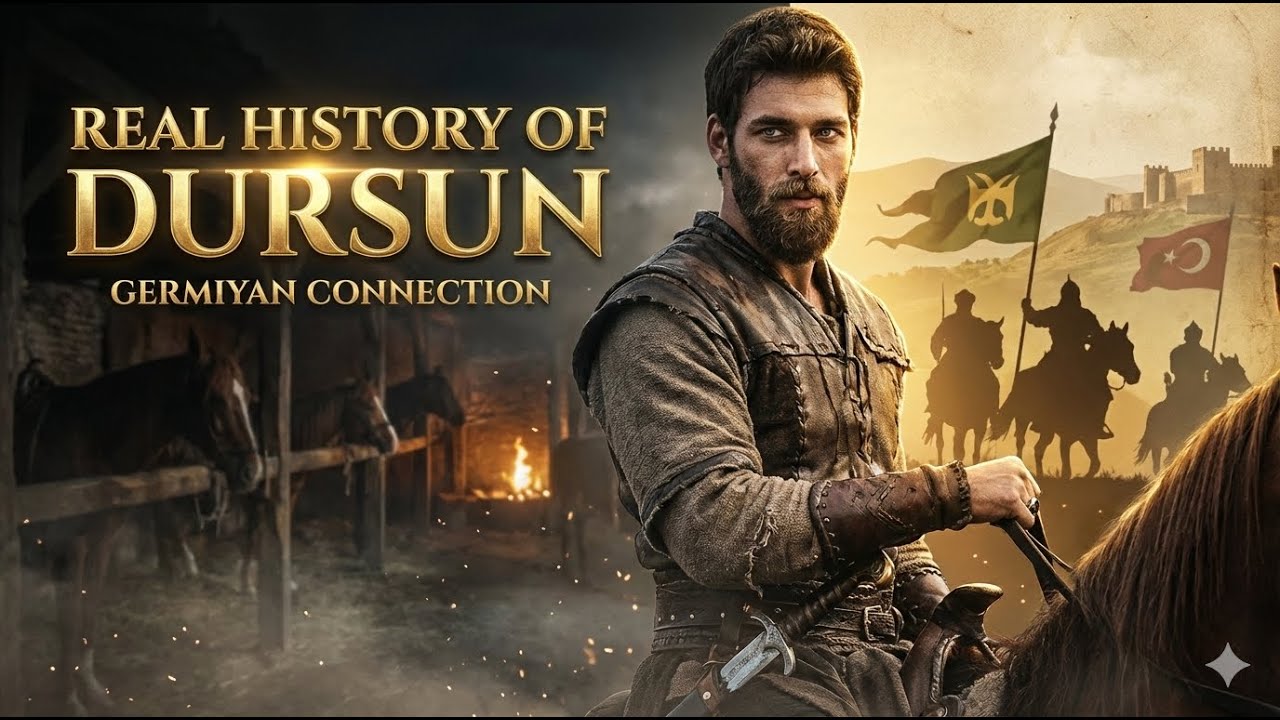
He cleans stables. Sleeps among horses. Speaks like an ordinary man. Yet when danger draws near, something changes. His eyes sharpen. His posture straightens. Even seasoned warriors fall silent. In Kuruluş Orhan, Dursun appears insignificant by design. But history tells a very different story. Behind the quiet behavior and humble role lies a man connected to one of Anatolia’s most powerful beyliks. Dursun’s silence is not weakness—it is strategy. And understanding who he really is helps explain where the story is heading next.
Fourteenth-Century Anatolia: A Land of Rising Powers
The world of Kuruluş Orhan is shaped by chaos. Seljuk authority has collapsed, leaving Anatolia divided among competing Turkish beyliks. Survival depends on timing, alliances, and restraint.
Among the strongest of these powers stood the Germiyan Beylik:
-
Renowned for elite cavalry
-
Holder of strategic western Anatolian lands
-
Both rival and eventual ally to the Ottomans
And inside Orhan Bey’s camp walks a man tied to this power—not as a prince or commander, but as a stableman.
Who Dursun Claims to Be
In the series, Dursun never presents himself as important. He introduces himself as:
-
A simple man from Germiyan lands
-
A former soldier
-
A wanderer searching for survival
On the surface, his story sounds believable. But his actions quietly contradict his words.
The Horse Knowledge That Reveals Everything
Dursun’s understanding of horses goes far beyond basic care. He knows:
-
Breeding lines
-
Stamina management
-
Battlefield readiness
This is not peasant knowledge. It is elite cavalry culture—the kind taught inside beylik households and among frontier nobles. Horses were the backbone of Turkic warfare, and mastery over them was a mark of status and training.
Dursun hides his past carefully, but this detail gives him away.
The Historical Power of Germiyan
Historically, Germiyan was not a minor state. It was one of the dominant Turkish beyliks in western Anatolia.
During Orhan Bey’s era, Germiyan was ruled by Mehmed Bey of Germiyan (c. 1340–1361), son of Yakub I. His reign was defined by:
-
Battles against Catalan mercenaries
-
Reclaiming lost territories such as Kula and Angir
-
Careful diplomacy with the rising Ottomans
The Germiyanids did not rush into alliances. They observed, measured, and waited. This mirrors Dursun’s behavior perfectly.
Why Dursun Chooses to Hide
If Dursun openly declared Germiyan nobility inside Orhan Bey’s camp, he would instantly become:
-
A suspected spy
-
A political hostage
-
A bargaining tool
Instead, he chooses invisibility.
Why the Stables?
Horses sit at the heart of Turkic military life. A man close to the stables:
-
Moves freely
-
Hears everything
-
Is trusted but rarely questioned
For someone watching a new power rise, it is the safest place to stand. Dursun’s role reflects historical reality—Germiyan nobles did not confront the Ottomans early. They waited until the future became clear.
Dursun Is Not Testing Loyalty—He Is Testing Destiny
Dursun is not betraying Orhan Bey. He is observing him.
History shows that Germiyan eventually aligned with the Ottomans not through destruction, but through calculated cooperation:
-
Marriage alliances
-
Territorial transfers
-
Political absorption
This is exactly the path the series is hinting toward. Dursun is not an enemy in hiding. He is a bridge between two powers still deciding whether to stand apart or unite.
The Forgotten Role Dursun Represents
Dursun symbolizes a type of figure history often overlooks:
-
The observer
-
The survivor
-
The silent strategist
Empires are not built only by men who charge into battle. They are also shaped by those who know when to remain quiet and when to step forward. Dursun’s secrecy is not cowardice—it is intelligence.