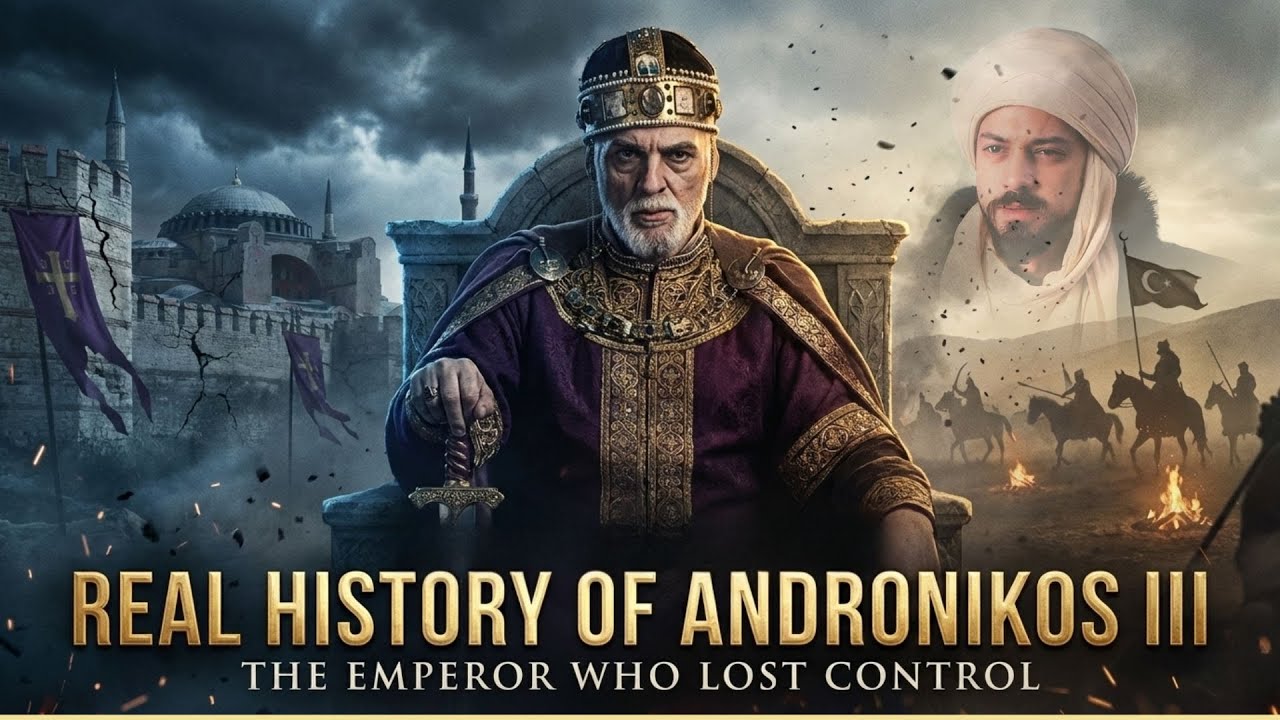
An emperor crowned through blood. A throne taken from his own grandfather.
And an empire collapsing faster than any army could save it. While the Ottomans were rising from the Anatolian frontier, Byzantium was breaking apart from the inside. At the center of this slow collapse stood Andronikos III Palaiologos—a ruler who believed he could restore imperial glory, only to discover that history had already moved on. His reign did not just shape Byzantium’s final centuries. It created the world that Orhan Bey was destined to conquer.
Byzantium in the Early 14th Century: An Empire in Name Only
By the early 1300s, the Byzantine Empire still called itself Rome—but Rome was already a memory.
The reality was harsh:
-
Cities were isolated and underfunded
-
The treasury was nearly empty
-
Armies relied heavily on mercenaries
-
Anatolia was slipping away to rising Turkish beyliks
It was into this fragile world that Andronikos III ascended the throne—young, ambitious, and convinced he could reverse centuries of decline.
A Throne Taken by Civil War
Andronikos III did not inherit power peacefully.
In 1321, he rebelled against his own grandfather, Emperor Andronikos II. What followed was a brutal six-year civil war that devastated the empire from within.
-
Provinces chose sides
-
Cities were ruined
-
Byzantine unity shattered
In 1328, Andronikos III emerged victorious. He entered Constantinople, deposed his grandfather, and crowned himself emperor. But the empire he claimed was already bleeding beyond repair.
Reforms Without Time
To his credit, Andronikos III tried to fix what generations had broken.
He attempted to:
-
Rebuild the Byzantine navy
-
Reform the military structure
-
Strengthen the judicial system
But reform requires stability—and Byzantium had none. While the emperor focused on internal recovery, a new power was advancing relentlessly from Bithynia: the Ottomans.
The Rise of Orhan Bey
Across the frontier, Orhan Bey was transforming his father’s legacy.
Under Orhan:
-
The Ottomans stopped being raiders
-
They became state-builders
-
Fortresses fell one by one
-
Trade routes shifted
-
Byzantine strongholds became isolated islands
Eventually, Andronikos III could no longer ignore the threat.
The Battle That Changed Everything
In 1329, Andronikos III personally led an army against Orhan Bey. This was not a proxy war or a governor’s campaign—the emperor himself marched east.
The armies met near Pelekanon, close to Nicomedia.
The result was disastrous:
-
Byzantine forces were defeated
-
Andronikos III was wounded
-
The psychological impact was immense
This battle confirmed a brutal truth: Byzantium could no longer stop the Ottomans in Anatolia.
The Fall of Bursa: A Symbolic Defeat
Just a few years earlier, in 1326, Bursa had fallen to Orhan Bey and became the first Ottoman capital.
For Andronikos III, this loss was more than military.
-
Bithynia, once the heart of Byzantine Asia, was gone
-
Constantinople still stood—but the future did not belong to it
From this point on, Byzantium was defending memories, not momentum.
Andronikos III in Kuruluş Orhan
In Kuruluş Orhan, Andronikos III is portrayed as a ruler surrounded by crises:
-
Internal betrayal
-
Foreign threats
-
Religious pressure
-
Military exhaustion
The series dramatizes his authority and compresses timelines, but the core portrayal is accurate. He is not an emperor expanding power—he is one trying to slow collapse.
Not Weak, Just Too Late
Andronikos III was not a weak ruler.
He was simply born into the wrong century.
He inherited an empire hollowed out by:
-
Endless civil wars
-
Economic collapse
-
Dependence on mercenaries
-
The irreversible loss of Anatolia
He ruled from 1328 to 1341. At just 44 years old, he died, leaving behind:
-
A child heir
-
A fractured empire that would never recover
The Last Emperor Who Believed
Andronikos III represents the final moment when Byzantium still believed it could fight back.
After him, the empire would survive—but only as a shadow of itself.
His reign overlaps perfectly with Orhan Bey’s rise:
-
One ruler struggling to preserve the past
-
The other shaping the future
History chose its side.